


AI’s Productivity Problem
AGI maximalists argue that AI will pay an abundance dividend: a step change in output that frees most people from the need to work. In other words, a fundamental departure from economic history. The scale of the claim and the investments deserve proper accounting with a view to bringing corporate financial discipline to the discussion around the AI buildout. Looking at the KPIs, it should be possible to identify measurable productivity gains, or the return on these investments, in the data from public and private companies. On today’s metrics, the companies buying AI show no measurable productivity dividend, let alone one large enough to deliver universal abundance and the leisure that is supposed to follow. The macro data does not settle the debate about AI ROI, despite the clear need for a return to the AI builders that can only be paid for through AI buyer productivity gains.
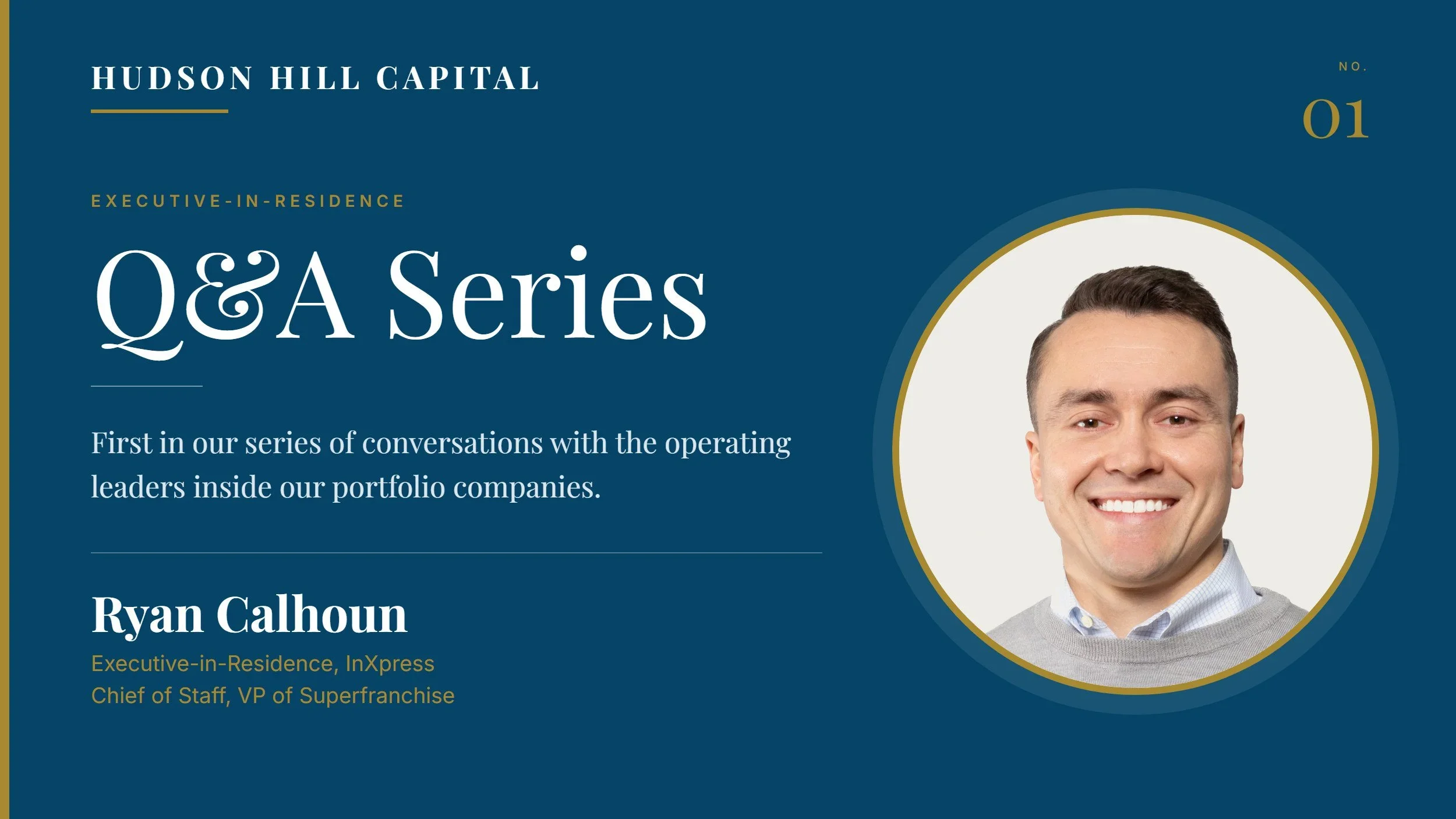
Ryan Calhoun: Transitioning From McKinsey to the Middle Market
Hudson Hill Capital's Executive-in-Residence (EIR) program pairs seasoned operating leaders with our portfolio companies to accelerate growth and sharpen execution. In the first installment of our EIR Q&A series, we sat down with Ryan Calhoun, Chief of Staff and VP of Global Super Franchise at InXpress, on what carried over from McKinsey to the middle market, the initiative he is most proud of, and what surprised him about operating inside a private equity-backed company.
![Inflation is a [the] policy](https://images.squarespace-cdn.com/content/v1/5c37a50eb40b9d3e9becca25/1789658685036-AC5XT0YF0XO5WL06CG4Z/inflation-is-the-policy-blog-1500.jpg)
Inflation is a [the] policy
Everyone watching the Federal Reserve for clues about inflation is watching the wrong institution. The Fed increasingly does not set policy that affects inflation. Instead, it operates within a fiscal dominance paradigm set by the legislative and executive branches, one that prioritizes electorally popular policy choices over fiscal responsibility. As a result, we face two uncompromising truths. First, the United States will neither raise taxes nor cut spending, despite budget deficits of nearly 6% of GDP. Second, “inflation is a policy” (Von Mises) that will persist in the U.S. for many years as the preferred path to restore balance to its budget deficits and debt-to-GDP.

Private Credit Is the New Banking System
One narrative has bothered me as a consumer of financial media over the past year: that “private credit is blowing up.” Private credit emerged to meet significant market demand after the Dodd-Frank regulations made lending uneconomical for traditional banks. Funds stepped in first, and integrated insurance platforms followed, supplying loan capital to the consumers and businesses whose financing needs persist regardless of the regulatory environment.

H2 2026 Market Commentary: An Investment-Led Upturn, Seen First in Freight
Hudson Hill’s business services companies touch a wide range of end markets, and in aggregate they give us an early read on where the economy is headed.

From Aristotle to Artificial Intelligence: How the Sudden Intersection of Philosophy, Computing Power, and Algorithms Transformed the Future of Intelligence
How did we “suddenly” get to the boom of Artificial Intelligence (AI) we live in? Artificial Intelligence is far from a recent or sudden invention. Powering everything from chatbots to self-driving cars, its origins trace back centuries.

Hudson Hill Go-to-Market Playbook
At Hudson Hill Capital, our portfolio companies view the Go-to-Market strategy as the cornerstone of their success. While many companies perform certain aspects of the GTM function, high-performing companies distinguish themselves by embracing a comprehensive GTM strategy. Comprehensive GTM focuses on creating sustainable revenue growth by integrating sales, marketing, customer insights, channel strategy, and sales enablement.

Strategic Budgeting: Driving Alignment, Accountability, and Value Creation
At Hudson Hill, we observe that the ability to translate strategic priorities into clear, actionable financial plans is a critical differentiator within our portfolio companies. As a result, we view budgeting as more than an annual exercise of selecting financial targets, but rather a strategic discipline that directly influences investment outcomes. We believe that budgeting should give rise to a detailed set of actions for the year, enabling businesses to allocate resources efficiently, track performance, and remain agile in response to market dynamics.

State of Economy — HHC 2025
Each year, we take time to reflect on the economic and capital market conditions that impact Hudson Hill’s portfolio companies. This year’s review represented an interesting moment in time, as our Leadership Summit coincided with the start of a new administration in the United States, which will lead to significantly altered conditions in each of the markets we reviewed. Nonetheless, a grounding in the current macro environment provides helpful framing for business decisions made every day in our companies.

How Interest Rates Impact M&A
Over the last fifteen years, zero interest rate policy (ZIRP) altered capital markets by impacting discount rates, which created a competitive advantage for private equity firms relative to other buyers of assets. This competitive advantage derived from the fundamentals of asset pricing — discounted cash flows (DCF) — which discounts free cash flows by a weighted average cost of capital (discount rate).

The Hudson Hill Playbook
Hudson Hill identifies high potential companies operating in large markets with attractive business models that require investment in people, processes, and systems to continue their growth. As the Hudson Hill portfolio grew, we noticed patterns of need from our businesses as they built scalable foundations across key functional areas.

The Hudson Hill Opportunity
In 2022, Edward Chancellor published a book called The Price of Time, which chronicles the historical relationship of economic activity with interest rates. The conclusion of the book is that low interest rates reduce labor and capital productivity by reducing the threshold for efficiency in the deployment of capital. Chancellor observes that long periods of economic malaise tend to follow periods of capital excess.

How Interest Rates Impact Roll-Ups
Over the past fifteen years, the private equity industry relied on M&A as a key pillar in value creation, thereby increasing its reliance on capital markets to finance returns. Over the next decade, higher interest rates will constrain access to capital for private equity owned businesses, lowering the attractiveness of debt funded M&A to generate equity returns.

How Interest Rates Drive Productivity
Much has been made over the past 15 months about the impact of rising rates. Rising interest rates portend an ominous environment for the holders of existing assets, particularly those asset holders that acquired (and therefore priced) investments during a period when interest rates were very low.

Sticky Situation
In this article we’ll explore the “Sticky Situation” we find ourselves in financially and economically. Decades of easy money met the COVID crisis, knocking the US and global economy off its goldilocks relationship with low interest rates, low inflation, and low growth.

Fiat Ate the World
I’m going to make a controversial statement — printing money doesn’t cause inflation — they gasp in horror! Though the books, economics classes, inflation theory, and even the Maestro’s autobiography say differently, I’m looking out at the world as a practitioner and seeing something different.

Visa Tastes Better with a Coke
They say, “imitation is the sincerest form of flattery that mediocrity can pay to greatness”. Perhaps we can alter the phrase to say “[adaptation] is the sincerest form of flattery…” as I’d like to mold a well-known talk Charlie Munger gave on July 20, 1996.

The Investment Paradox — Why ROICs Matter in Investing
At HHC, we believe that the likely return on invested capital for a business over the next 5–10 years should drive the type of transaction we engage in rather than arrive to the scene with a prescriptive approach.

What Is Risk?
If you asked a group of business school professors to define “risk”, they would dutifully reply, “beta”. Define “beta”, you may respond.

Solving the Principal/Agent Problem
One can trace the roots of capitalism through family business. Since 718, the same family has operated the Hoshi Ryokan, a Japanese inn.