
Inflation is a [the] policy
Key Takeaways
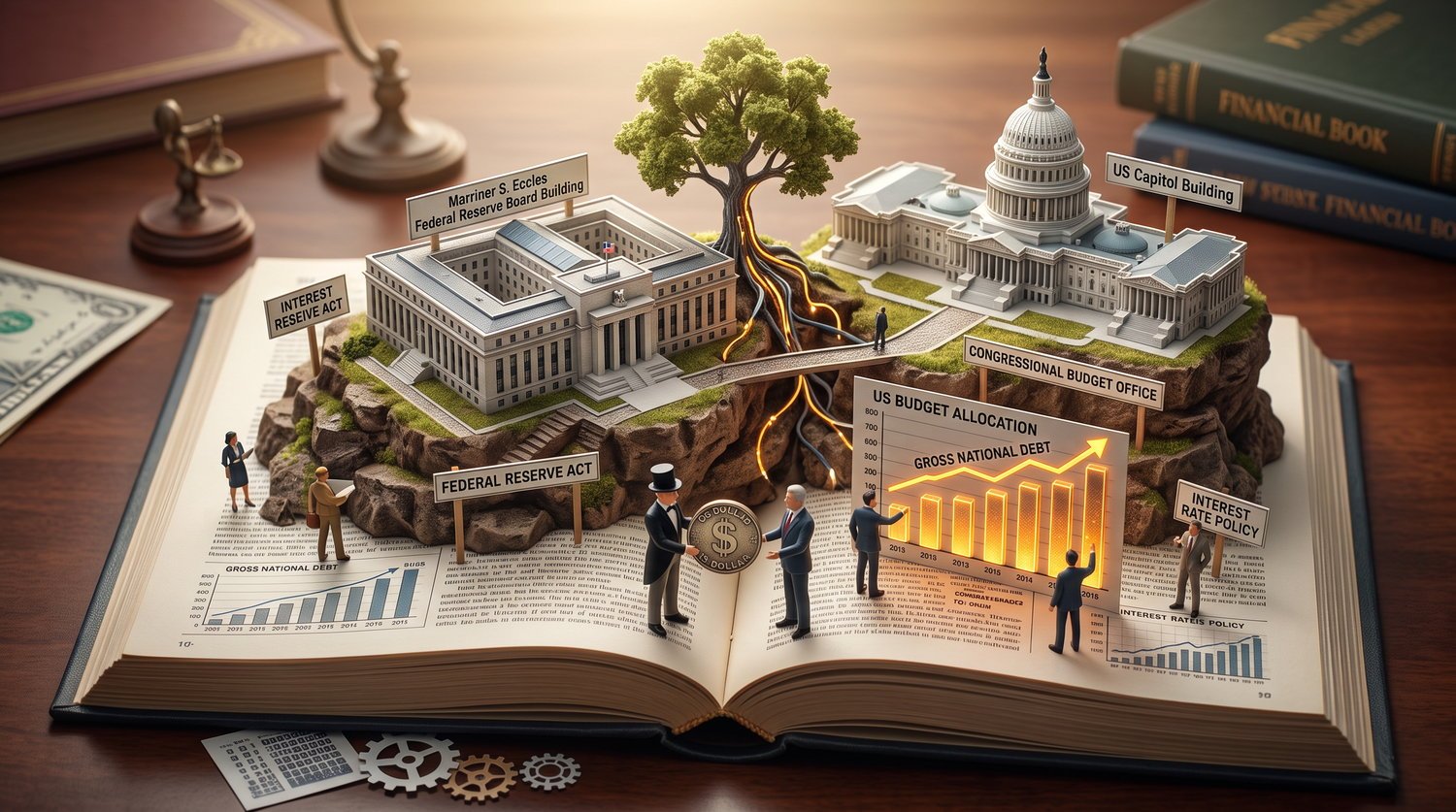
Fiscal policy, not the Fed, now determines inflation. The Fed operates within a fiscal-dominance paradigm set by Congress and the White House—one that will neither raise taxes nor cut spending, even with a deficit near 6% of GDP. Watching the Fed for clues is watching the wrong institution.
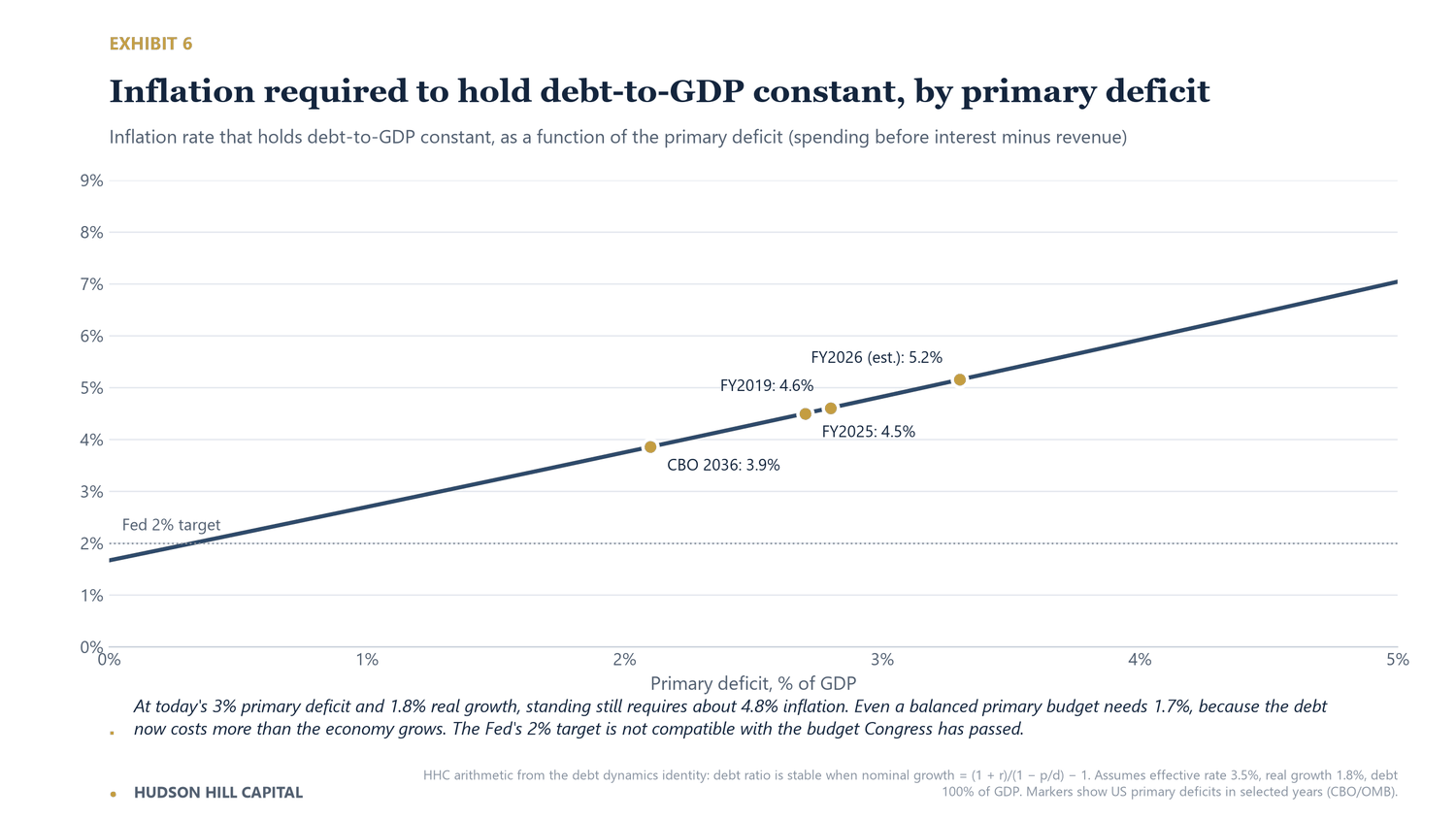
Roughly 5% inflation is the arithmetic, not an accident. With debt/GDP at 100%, a 3% primary deficit, and a 3.5% effective interest rate, the debt ratio stabilizes only at ~6.7% nominal growth. At 1.8% real growth, that means 4.8% inflation — so the Fed's 2% target cannot coexist with the tax and spending bills Congress just passed.
There is no growing out of $145 trillion. Publicly held debt, trust-fund IOUs, benefits payable, and the 75-year Social Insurance shortfall total ~$145T against $32.5T of GDP and $5.2T of federal receipts. Debasement is the only politically survivable path, and every major precedent (the U.S. after WWII, Britain, France, Rome) took it.
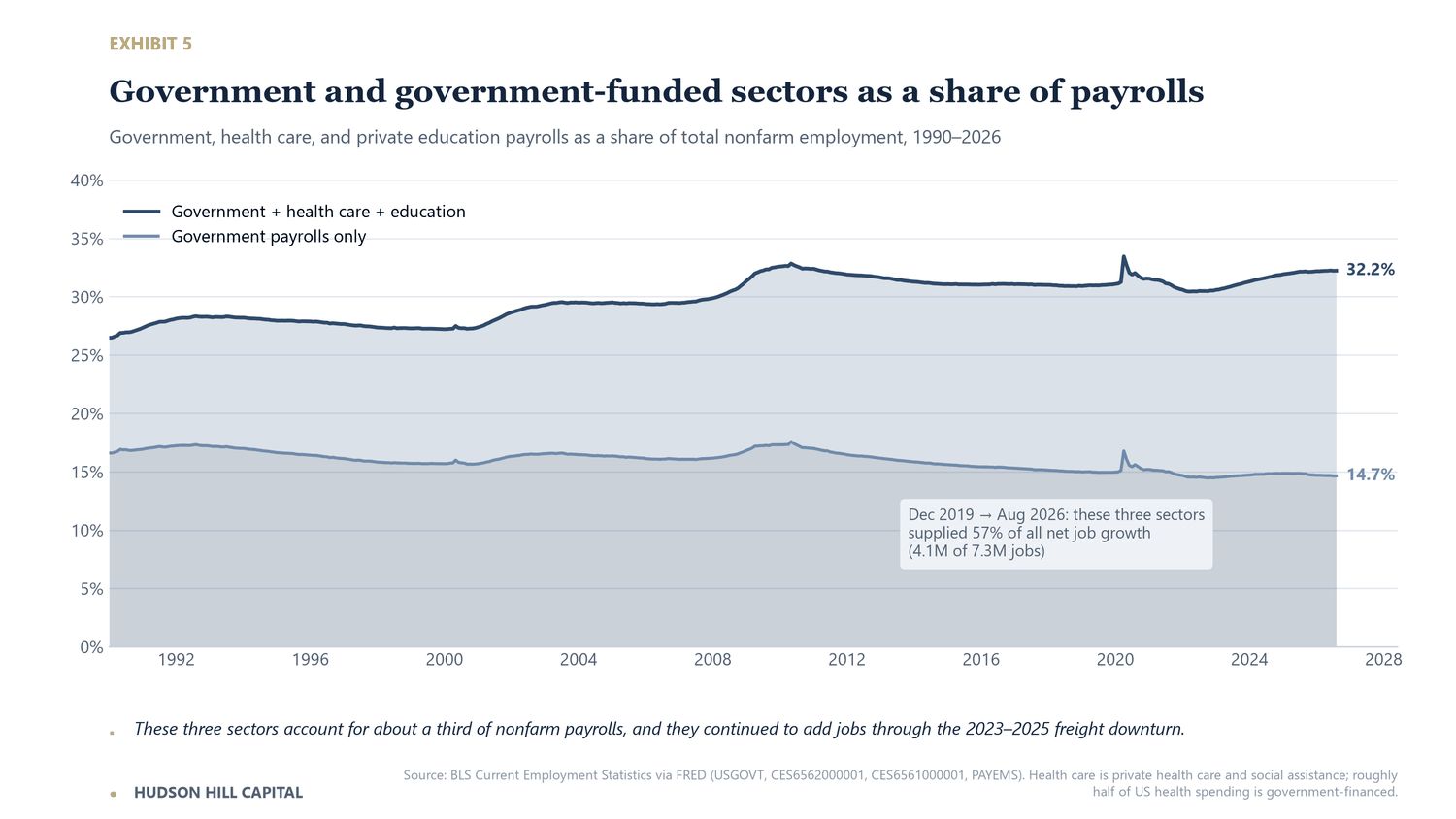
The government economy has crowded out the cycle. Direct expenditures are 35% of GDP; add healthcare, education, utilities, and housing backstops, and government drives 55%. One dollar in five of personal income is now a government check, up from one in sixteen in 1959. Transfers don't fall in recessions, so there's no cleansing low and no capitalist high — freight operators lived through a 2023–2025 recession the headline numbers never called.
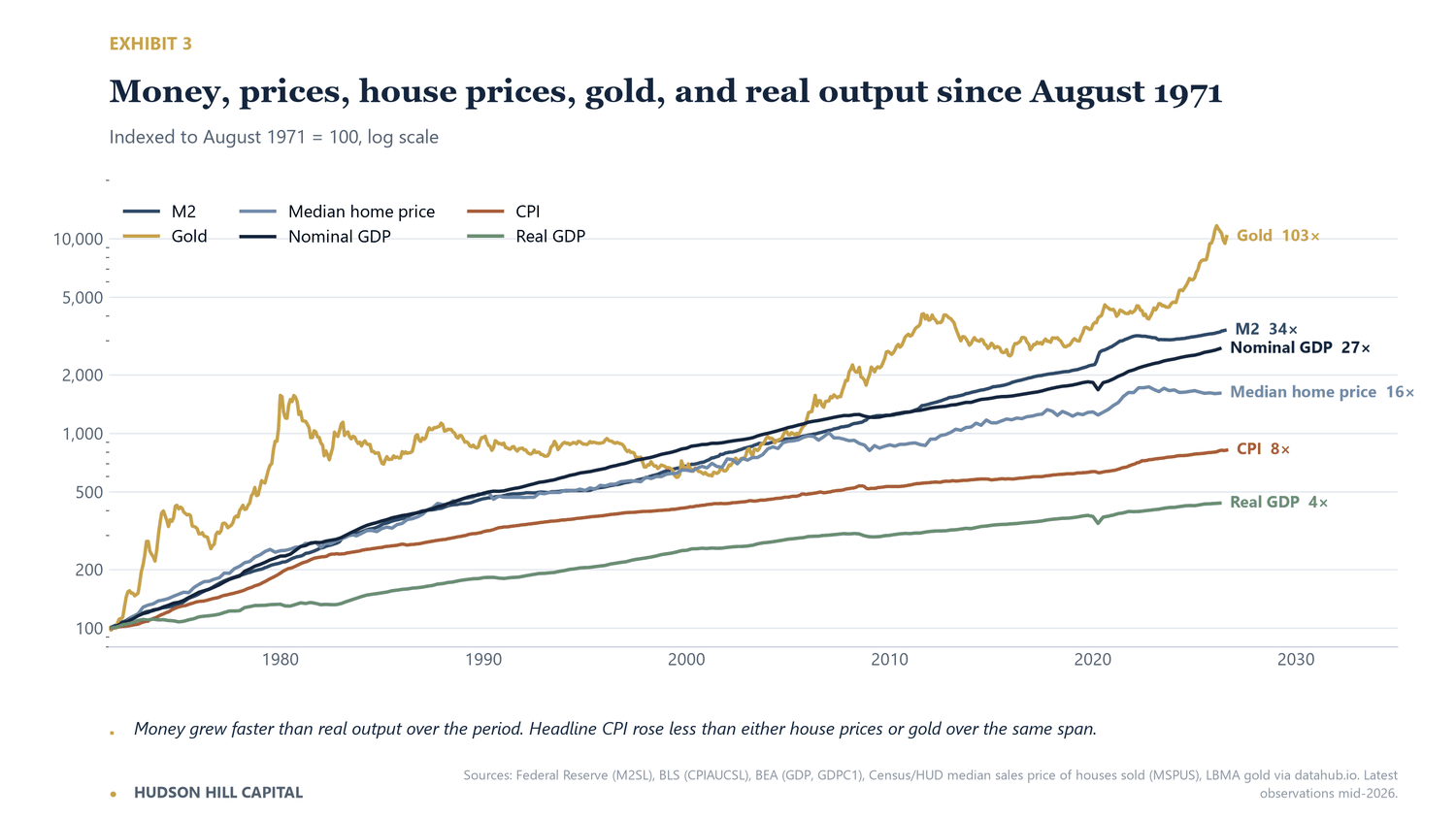
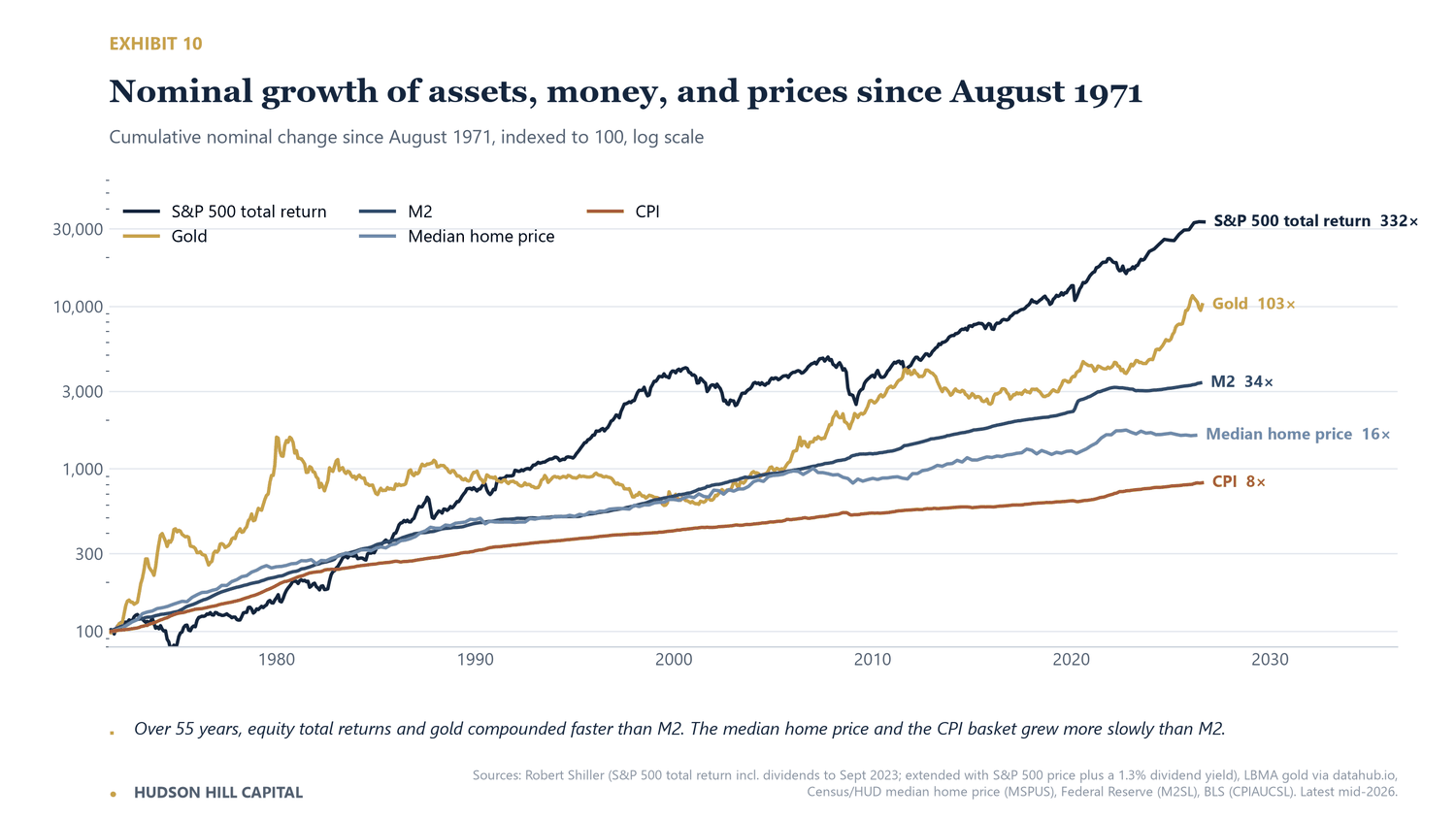
Inflation is a regressive tax. M2 holders lost ~$1.7T of purchasing power in 2022 alone, half that year's federal income tax; 3.4% inflation costs the median household ~$2,850. Wage earners, savers, pensioners, and first-time buyers pay it. Since August 1971, the S&P with dividends is up 330x and gold 103x against 8x for CPI — asset-light businesses with real pricing power are what survive a sustained debasement.
Everyone watching the Federal Reserve for clues about inflation is watching the wrong institution. The Fed increasingly does not set policy that affects inflation. Instead, it operates within a fiscal dominance paradigm set by the legislative and executive branches, one that prioritizes electorally popular policy choices over fiscal responsibility. As a result, we face two uncompromising truths. First, the United States will neither raise taxes nor cut spending, despite budget deficits of nearly 6% of GDP. Second, “inflation is a policy” (Von Mises) that will persist in the U.S. for many years as the preferred path to restore balance to its budget deficits and debt-to-GDP.
A government funds itself in three ways: tax production, borrow against future production, or print claims on it. The output of productive assets, not the government’s monetary overlay that “Fed Watchers” spend time parsing, determines economic success. China categorizes its economic statistics within a pyramid of production with three parts: primary industry (agriculture, forestry, husbandry, and fishing), secondary (mining, manufacturing, utilities, and construction), and tertiary (services). Each layer builds on the others. Service economies cannot exist without primary and secondary industries. At the same time, despite the government’s best efforts to convince the population otherwise, money is not production.
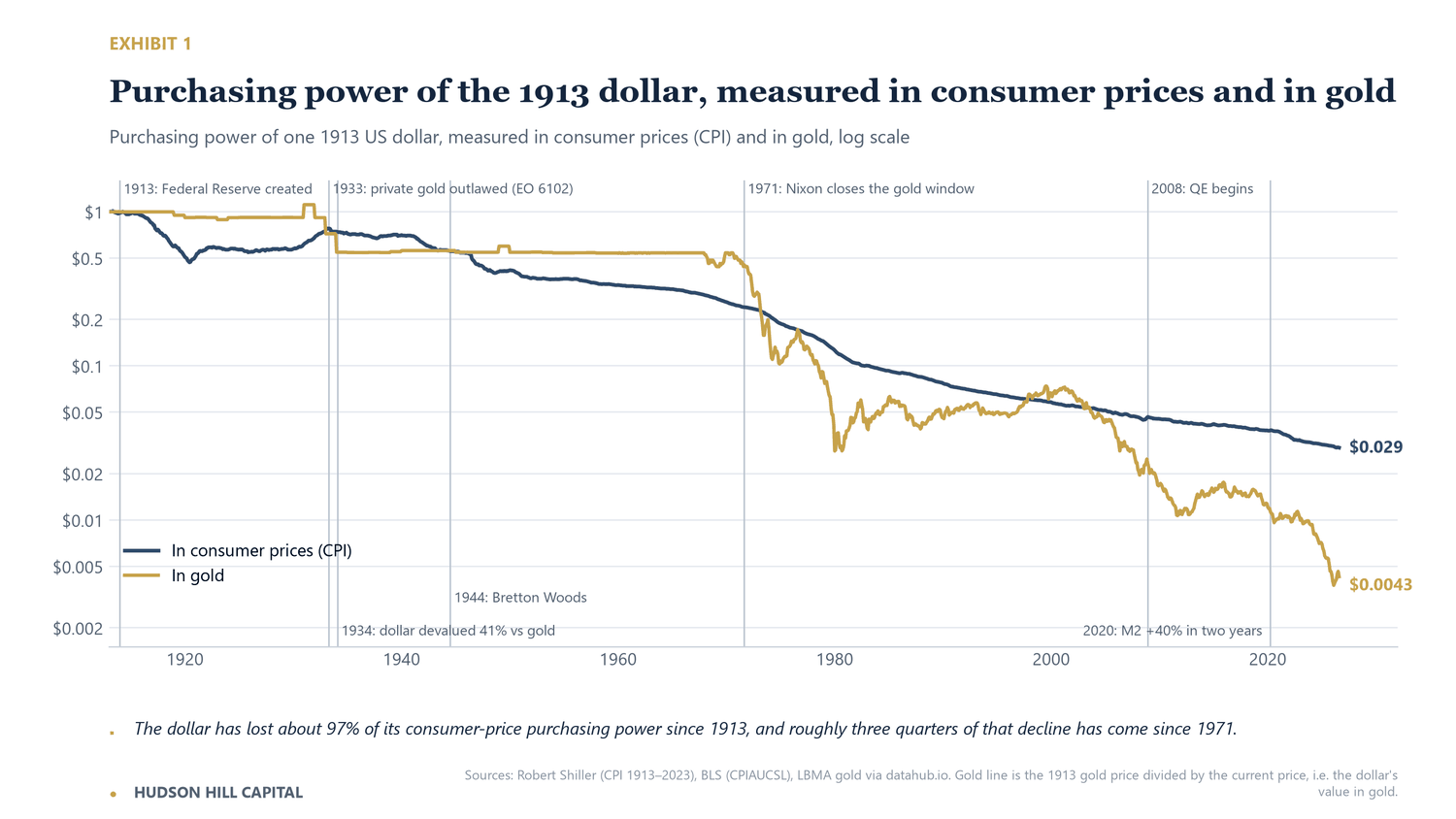
The development of the common currency system created the perception that the government participates in production. It does not. A currency monopoly benefits commerce but gives governments a way to extract resources from the population without the legislative consent the constitution requires for taxation, borrowing, and spending. In 1971, Nixon directed Secretary Connally to temporarily suspend the dollar's convertibility into gold or other reserve assets, permitting an orderly sovereign default that allowed the U.S. to debase its currency to offset the fiscal impacts of excessive spending. In doing so, the US set in motion the consistent, predictable pattern of currency debasement to avoid the politically unpopular choices of raising taxes or cutting spending. As a result, U.S. currency measured in gold terms has eroded to virtually nothing over the last 113 years.
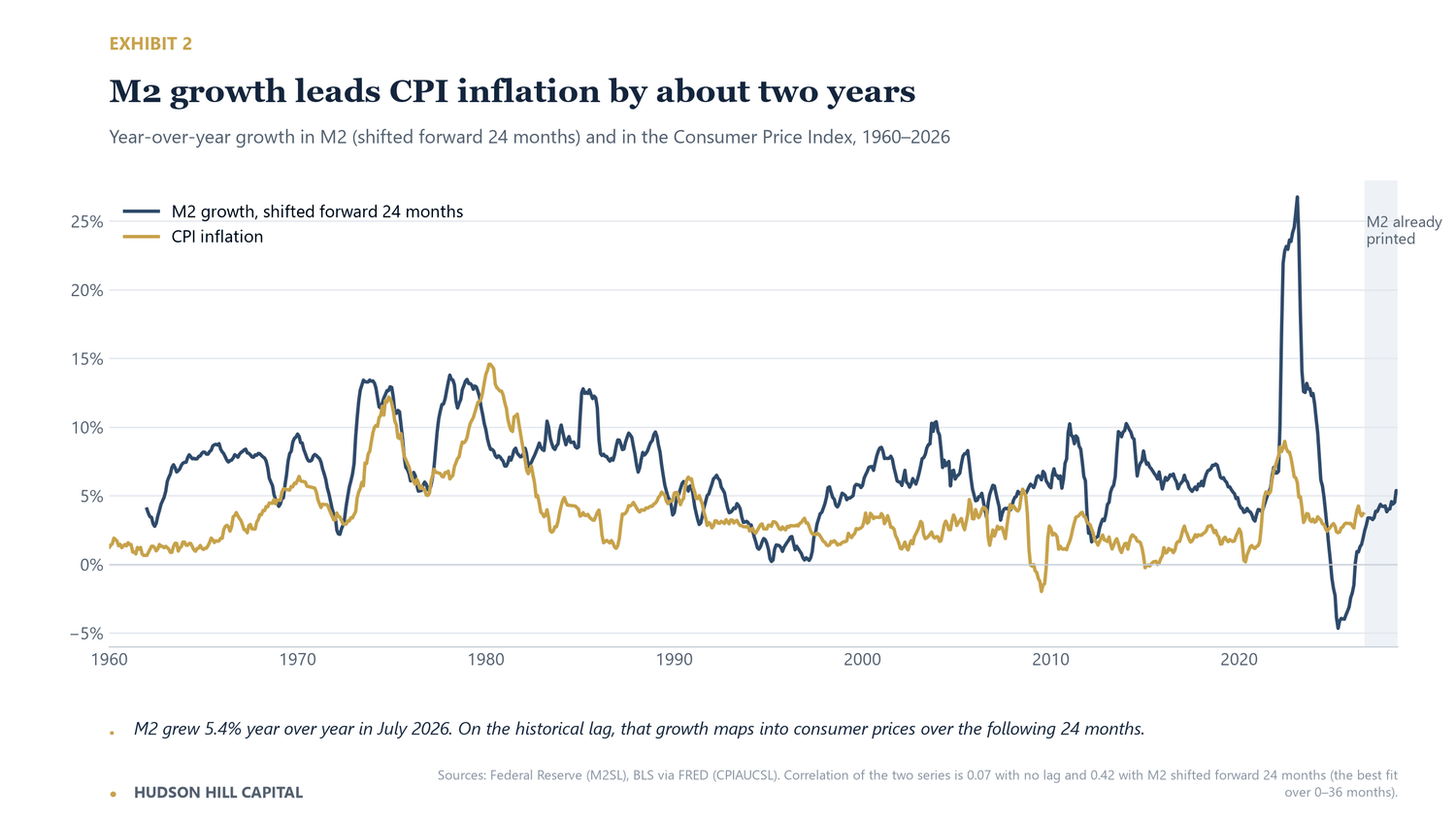
Inflation happens when money supply grows faster than real production, adjusted for the velocity of money. Government spending is how money supply increases, and prices respond in stages: government contractors and transfer recipients first, then asset prices, and lastly wages and fixed incomes. Murray Rothbard, called inflation “a race to see who can get the new money earliest”. The current U.S. fiscal situation makes the outcome close to mechanical. Printing money to balance government payment obligations requires money supply growth that runs ahead of real output growth.
Episodes like the Great Depression left policymakers biased toward excessive government intervention during periods of economic contraction. In a 1933 open letter to President Roosevelt, John Maynard Keynes advocated a “somewhat comprehensive socialization of investment”, calling for government intervention within capitalist boom and bust cycles. Keynes wrote in General Theory, “The right remedy for the trade cycle is not to be found in abolishing booms and thus keeping us permanently in a semi-slump, but in abolishing slumps and thus keeping us permanently in a quasi-boom.” The issue with Keynes’ approach, which U.S. bureaucrats have practiced for nearly a century, is that it increasingly displaces the productive economy with the government economy, utilizing current debasement to achieve its unrightful claims on production. Mises wrote, “There is no means of avoiding the final collapse of a boom brought about by credit expansion. The alternative is only whether the crisis should come sooner as the result of a voluntary abandonment of further credit expansion, or later as a final and total catastrophe of the currency system involved.” The impact of repeated government intervention within the U.S. economy is easy to see, with direct government expenditures now representing 35% of total GDP.
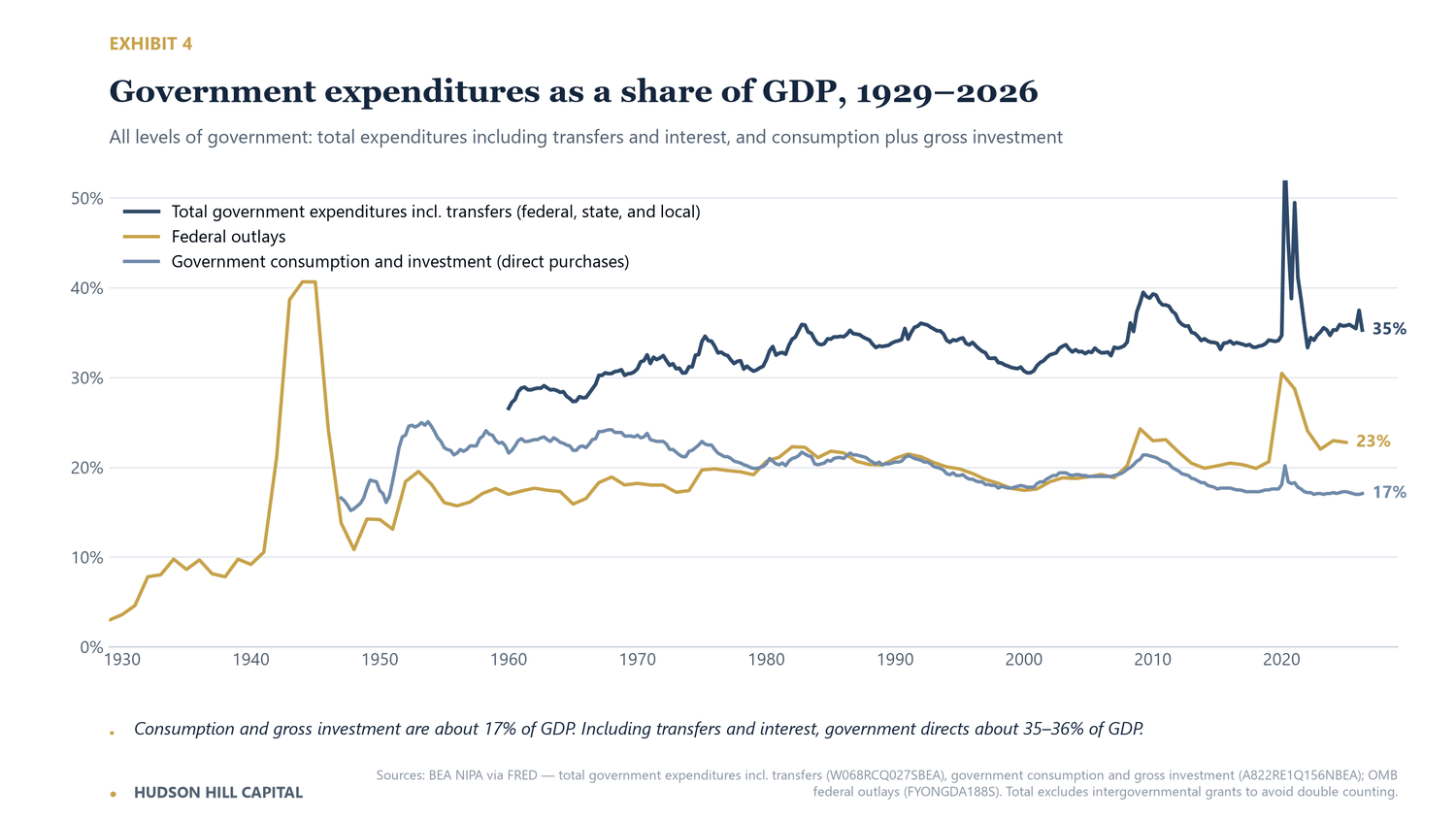
Whether 35% of GDP strikes you as a lot or a little, this statistic understates government involvement in the economy. The government generates about 17% of GDP through consumption and investment, such as soldiers, teachers and roads. It directs about 35% once you add transfers and interest, meaning Social Security, Medicare, Medicaid, and debt service. The 17% is the textbook big G. The extra 18% shows up in the data as consumer spending, which is why everyone around you has been remarking that we haven’t seen a recession for 20 years. One dollar in five of personal income is now a government check, up from one in sixteen in 1959. On top of the 35%, the government finances 47% of the $5.3 trillion healthcare sector and sets the reference prices for the other half. Education is largely government-financed and regulated, and utilities and housing finance operate under government backstops. Put it all together, and government involvement drives 55% of U.S. GDP, which is why every cycle feels flatter and poorer. Transfers do not fall during recessions, so there is no cleansing low and no capitalist high. As operators in the freight industry, we can speak with utter certainty that a recession occurred from 2023 to 2025, but the headline numbers never called it.
Austrian-American political economist and philosopher Ludwig von Mises wrote in Human Action, “The government has no more ability than individuals to create something out of nothing … For every unprofitable project that is realized by the aid of the government there is a corresponding project the realization of which is neglected merely on the account of the government’s intervention.” The government is crowding out economic activity, and the numbers show it. Since Q4 2019, federal spending is up 62%, consumer spending up 50%, GDP up 48%, and real GDP up 16%.
The government’s commitments also vastly exceed the current headline $40 trillion of debt. Start with $32.4 trillion of publicly held debt and $7.7 trillion of trust-fund IOUs. The Treasury lists $15.5 trillion of federal employee and veteran benefits payable and $2 trillion of other liabilities, and its Statements of Social Insurance put the 75-year shortfall in Social Security and Medicare at $88.4 trillion. State and local governments owe $3.8 trillion in debt and nearly $3 trillion of unfunded pensions and retiree health. That is $145 trillion of obligations against a notional GDP of $32.5 trillion and federal tax receipts of $5.2 trillion. In other words, big numbers the U.S. government cannot afford in today’s dollars.
The Trump 2.0 administration keeps saying we must “grow our way out” of our current fiscal situation. With public debt to GDP at 100%, a primary deficit (before interest) at 3% of GDP, and an effective interest rate on the debt at 3.5%, the debt ratio is stable only if nominal GDP grows at about 6.7% a year. At 1.8% real growth, that implies 4.8% inflation. In other words, the Fed’s 2% inflation target cannot be met through the permanent tax cuts and spending Congress recently passed. When both the Trump and Biden administrations decided not to touch taxes or spending, both administrations effectively declared: “inflation is a [the] policy”.
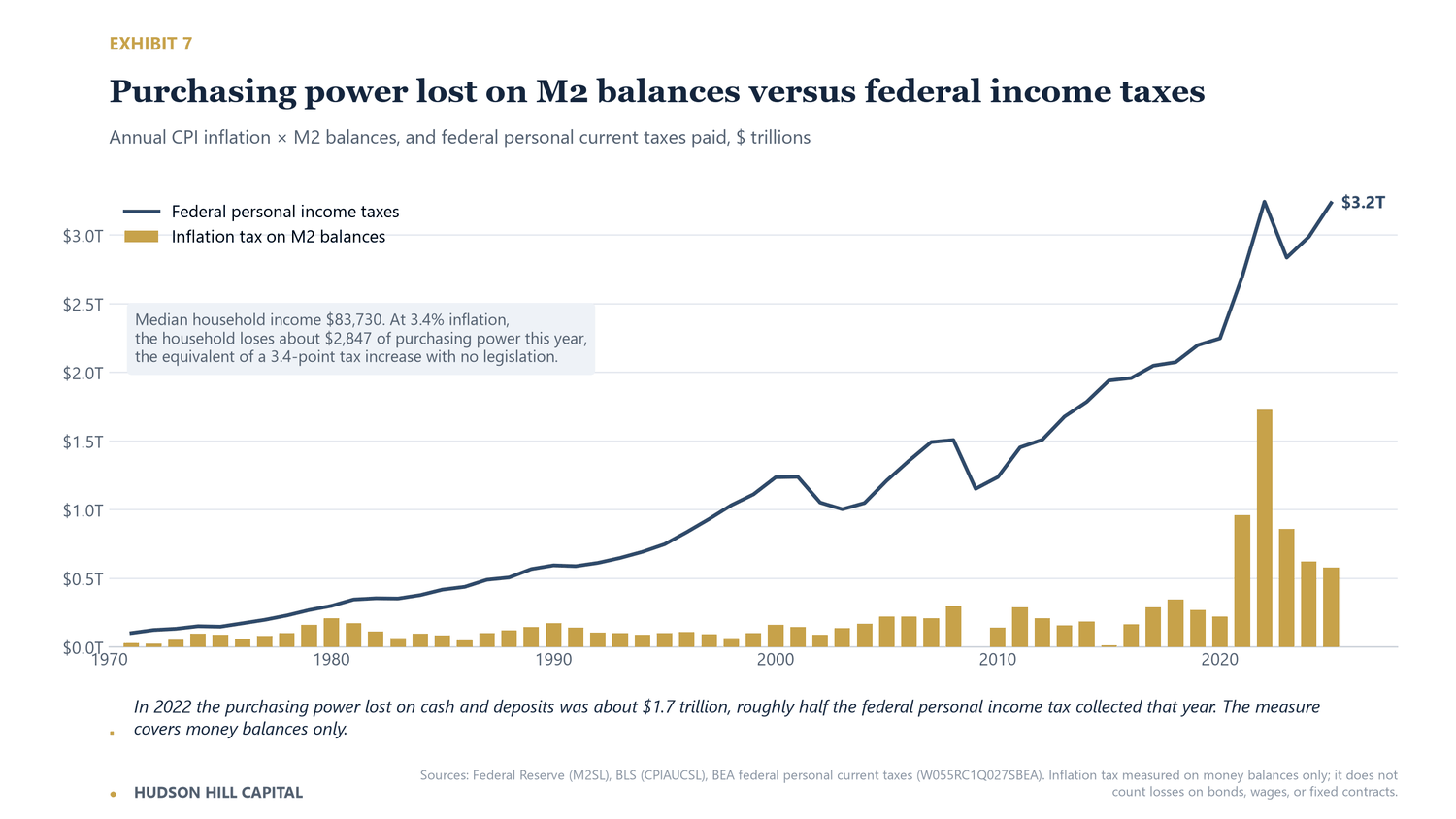
What makes inflation so pernicious is that it comes from policy choices that would not survive if any government put them up for a vote. No one would vote for a regressive tax increase. Inflation delivers one anyway. The purchasing power lost on M2 balances alone was about $1.7 trillion in 2022, half the federal personal income tax that year, and that excludes losses on bonds, fixed contracts, and wages. For a median household ($83,730), 3.4% inflation is about $2,850 of purchasing power this year, the equivalent of a 3.4% increase in its effective tax rate. Those who pay this tax are the late receivers of new money: wage earners, savers in deposits and bonds, pensioners with fixed benefits, and young first-time house buyers.
No one voted for this policy and no one will announce it, but the implications are worth tracing. When the fiscal authority moves first and runs deficits that the bond market will not absorb forever, the central bank “is forced to create money and tolerate additional inflation” (Sargent & Wallace, 1981). So expect the Fed to manage short rates down, because the budget cannot bear higher ones, while longer-term rates price inflation and deficits. Increasingly, the Treasury will lean harder on shorter-duration, lower-cost debt to finance itself. At some point, the Fed and Treasury will attempt to intervene in longer-duration government and quasi-government lending markets (e.g., mortgages) to mute the broader economic impact of higher longer-term rates.
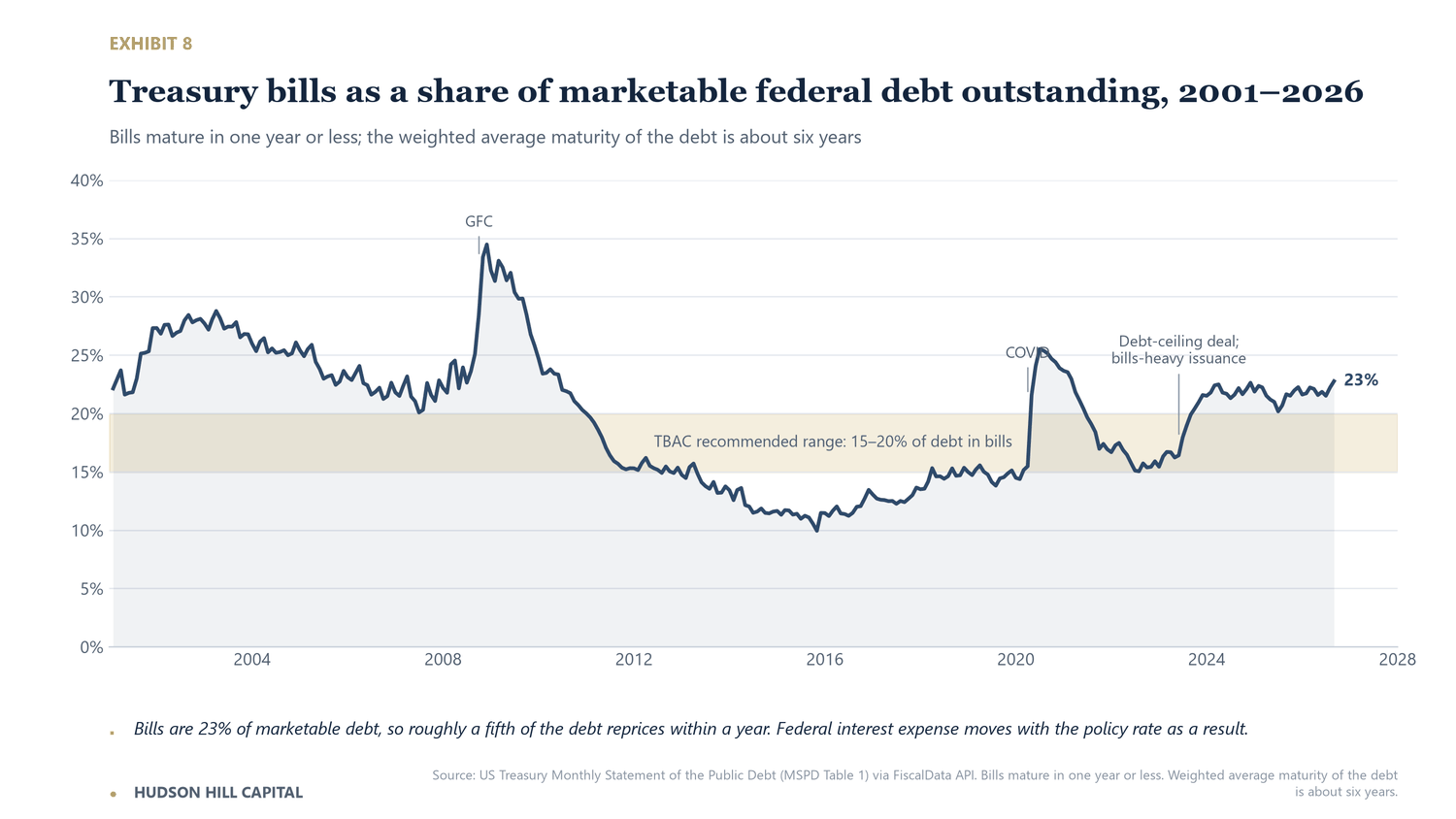
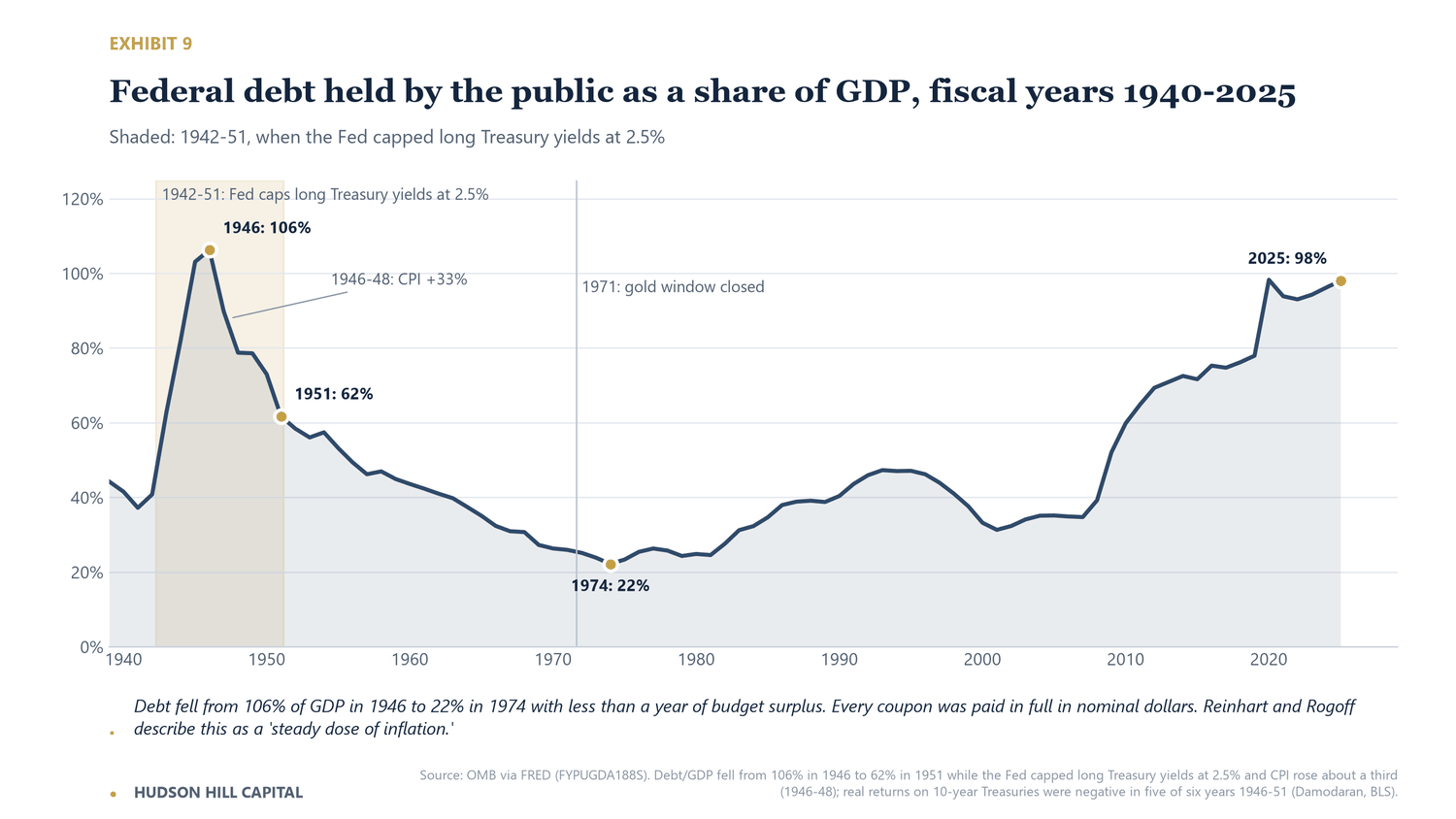
Managed inflation as a route to sovereign default has plenty of precedent. After WWII, U.S. debt held by the public fell from 106% of GDP to 22% with less than a year of budget surplus. Britain went from 250% debt to GDP in 1946 to 62% by 1972, with about 60% of the decline from growth exceeding real rates, rather than surpluses. France inflated away 80% of its war debt in the 1920s, and the Roman denarius went from about 95% silver under Augustus to under 5% 250 years later. Closer to home, the Reform Act of 1977 created a “stable prices” mandate for the Fed, which to me means 0% inflation. January 2012, it revised this mandate to 2% a year. In August 2020, it loosened it again to “average” inflation.
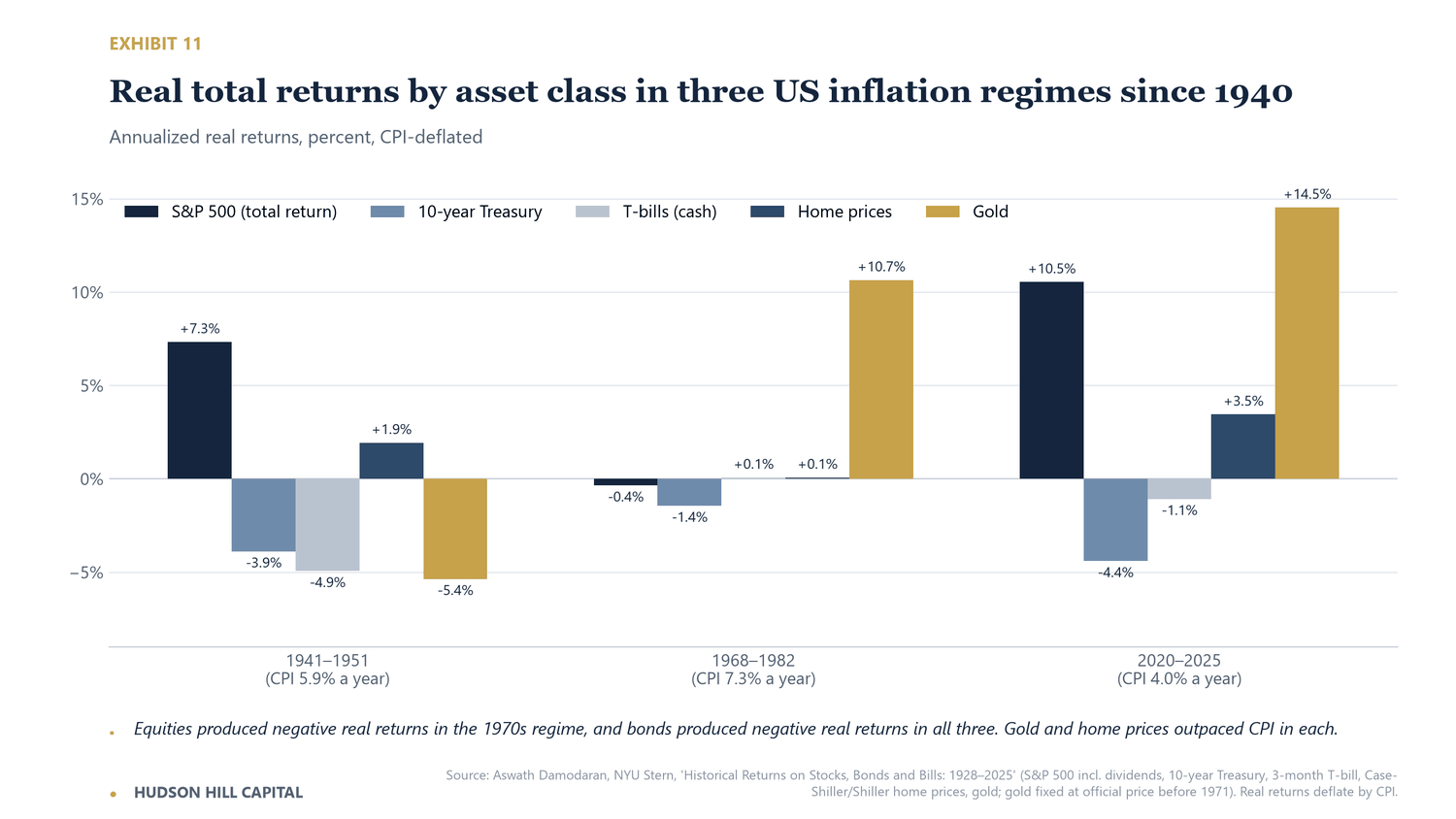
We must stop watching the Fed, breathlessly awaiting the next Paul Volcker. No bureaucrat is coming to save us from an inflation our own policy selection made inevitable. Prior inflation episodes underscore the value of scarcity and pricing power. Since August 1971, the S&P with dividends is up 330x, gold 103x, M2 34x, the median house 16x, and CPI 8x. Cash and the CPI basket are the only two things that don’t keep pace with the printing press. Warren Buffett gave his advice on inflationary environments twice, 30 years apart. Buffett, Berkshire 1981 letter: “Such favored business must have two characteristics: (1) an ability to increase prices rather easily (even when product demand is flat and capacity is not fully utilized) without fear of significant loss of either market share or unit volume, and (2) an ability to accommodate large dollar volume increases in business (often produced more by inflation than by real growth) with only minor additional investment of capital.” “For inflation acts as a gigantic corporate tapeworm.” Buffett, Berkshire 2011 letter: “Ideally, these assets should have the ability in inflationary times to deliver output that will retain its purchasing-power value while requiring a minimum of new capital investment. Farms, real estate, and many businesses such as Coca-Cola, IBM and our own See’s Candy meet that double-barreled test. Certain other companies – think of our regulated utilities, for example – fail it because inflation places heavy capital requirements on them.” Asset-lite businesses with pricing power and the ability to grow gross and real earnings are what thrive during periods of sustained inflation.
So, we end where we started, with Mises: “Inflation is a policy. And a policy can be changed”. If governments shift their revenue and expense trajectory towards surplus, our conclusions change dramatically. Until then, hold on tight because we’re about to run it hot.