
Ryan Calhoun: Transitioning From McKinsey to the Middle Market
Hudson Hill Capital's Executive-in-Residence (EIR) program pairs seasoned operating leaders with our portfolio companies to accelerate growth and sharpen execution.
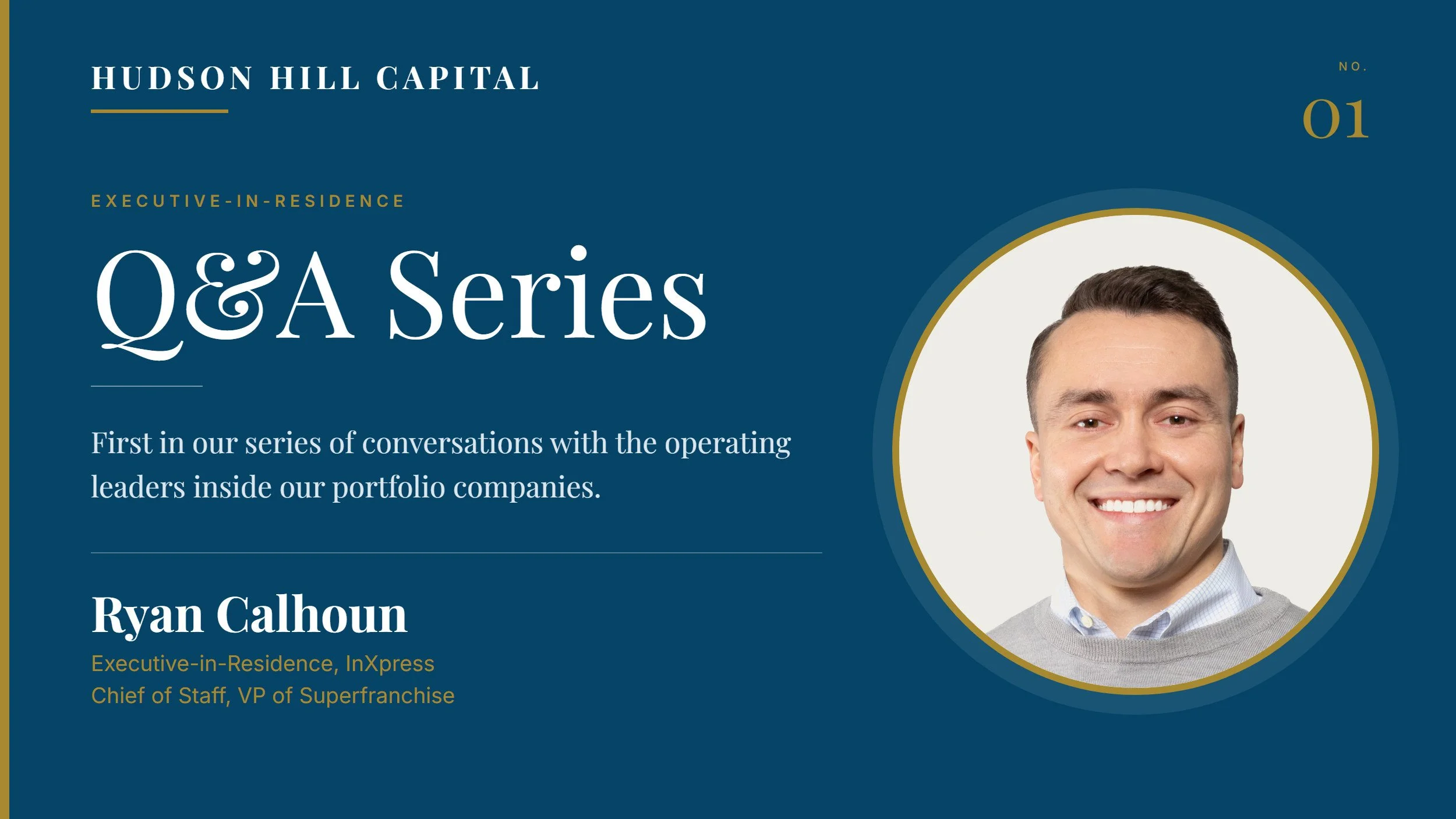
In this installment of our EIR Q&A series, we sat down with Ryan Calhoun, Chief of Staff and VP of Super Franchise at InXpress, a global shipping and logistics franchise network that spans 450 franchises and more than 46,000 customers across 14 countries. In this conversation, Ryan addresses the challenges he tackled, what surprised him along the way, and the lessons other operators can take from the experience.
Tell us about your background and what led you to join Hudson Hill Capital's Executive-in-Residence program.
I trained as an engineer and started out in automotive design at Ford. My first two years were a rotational program, centrally funded through HR, which moved me across several functions in product development and manufacturing. A mentor pushed me to explore parts of the business beyond engineering, so I spent a few months in advanced product marketing and strategy. That's where things really clicked for me: I like working at 30,000 feet a lot more than I liked working in millimeters and grams. It also didn't escape me that most of the people around me had MBAs and had come out of consulting.
I entered Harvard Business School (HBS) with the goal of going into consulting after completing my master’s in business administration. In my second year, I got interested in middle-market and lower-middle-market businesses. There's a popular class at HBS on the subject, and I looked hard at search funds and CEO-in-residence programs. I didn't think I had the strategic and analytical toolkit yet, or the self-confidence, to pull that off straight out of school, and my plan was to build those skills at McKinsey.
Once my partner and I had a kid, the consulting lifestyle became unsustainable, but my interest in smaller businesses never went away. Toward the end of my time at McKinsey, the Hudson Hill opportunity came up and it lined up with what I'd liked about consulting, what I hadn't liked about a Fortune 500, and the culture, ownership, and pace I wanted next.
Coming out of consulting, I wanted three things that are hard to get in a single job: P&L ownership, M&A exposure, and time in a boardroom. The EIR program was the clearest path I found to all three, and Hudson Hill was flexible in helping to come up with a specific role for me that would give me the experience I was looking for.
Which portfolio company did you partner with, and what was the situation when you stepped in?
InXpress. Two things made it the right match.
The first was what the business needed set against what I do well. InXpress needed structure and organization behind its strategic priorities, someone to drive accountability, and better analytics. When Hudson Hill acquired the company, sales programs like Apex and Super Franchise didn't exist. They're still fairly young, but the basic structure is there, and we have the right people in the right seats. Now it's about driving accountability so the performance follows. And on the analytics front, I wanted to bring that consulting discipline with me to track KPIs across the organization more consistently and rigorously, which aligned closely with Hudson Hill’s priorities.
The second was the people. I get on well with the executive leadership team. It's a fairly extroverted, social group, which is how I'd describe myself. We work hard, and we have fun doing it, and not only at dinners. Even the weekly ELT calls stay light-hearted without losing any urgency. The global nature of the business mattered too. I'd spent years on consulting engagements with multinational teams across continents, and that's central to how InXpress works, with 450 franchises across 14 countries. Super Franchise alone covers the US, Great Britain, and Australia. I like working with global teams and adapting to the cultural differences between them.
What was the central challenge or opportunity you focused on first, and why did it rise to the top?
Two answers, one about me and one about the work.
The personal one was credibility. I needed people to understand I wasn't a consultant who'd show up, bite their ankles, and add nothing. That part was relatively straightforward: offer to learn, help and build goodwill.
The work one was personnel, and it came first because it had to. Early on I was assessing skill, will, and culture fit across my organization. Inheriting an organization, finding structural incompatibilities and then acting on them for the long-term good of the business was the hardest thing I did in my first year.
Walk us through the initiative you're most proud of. What did you do, and how is it playing out?
It's the Super Franchise work, which wasn't even in the original job. The scope was Chief of Staff. I came in as an experienced hire, the first MBB person the company had brought in, and I'd said throughout the process that I wanted to own a P&L. That's how I ended up as Chief of Staff and VP of Super Franchise.
What this title actually means: I oversee our global super franchise footprint across the UK, Australia, and the US. Super franchises are corporate-owned and capitalized franchise locations developed in partnership with some of our top-performing franchisees. We gave them the opportunity to participate in a liquidity event while remaining in the business, and in exchange, they committed to outperforming the network average. We provide the capital to hire sales reps so they can grow at a much faster clip than the rest of the network. It's how we turbocharge growth alongside people who already have that mindset.
What I'm proudest of is less any single decision than what Super Franchise is becoming, along with what we're doing through Apex and franchise sales. Strip it back, and Super Franchise comes down to whether we can identify, recruit, coach, mentor, and keep talent over the long term. This is a sales engine, and the engine runs on people staying with us and doing well here. The other half is technology. Sales will be enabled by tech, and growing the footprint only works if franchisees and customers experience high-quality, frictionless shipping. That part overlaps with my chief of staff work.
What excites me is the career math for the people in those locations. A 23-year-old sales rep here talks to CEOs and small business owners and learns operations, supply chains, logistics, and how a business actually runs. That's rare exposure that early. If they commit to our playbook and our growth vision, they can earn meaningful income and several promotions over five years, move up to sales manager, run a team, and eventually become the next franchisees and the next super franchises. That multiplier effect is what I'm building toward: take our own talent, develop them, and grow the network through them. Ours is a relationship business, and it starts with the field sales workforce. If they're successful, Super Franchise and InXpress are successful.
What surprised you most about operating inside a private equity-backed company compared to your prior roles?
How little of the McKinsey approach transfers over as-is. I came in running meetings the way I'd always run them: slides for everything, a set agenda, a particular way of doing things that's core to the McKinsey culture. Inject that into a lower-middle-market business, and it can be jarring. You have to take the pieces worth keeping and adapt them rather than cramming the whole thing in. I still bring structure, but I adapt it to how InXpress does things in a way that makes people here comfortable. No square pegs in round holes.
Looking back, what's the biggest lesson you'd pass on to another operating executive stepping into a similar situation?
Credibility and rapport with your peers, before anything else. Make it clear you're there for the long-term interests of the business, not for yourself and find ways to be useful to the people around you. They need to be comfortable, and ideally excited, about getting behind you and putting their trust in you. Nothing else works until that does.
Second, put structure in place, to whatever degree the company can absorb it. That's often where we add the most value. Work out your governance model and your meeting cadence, then institutionalize them.
Third, ruthless prioritization. There's an endless amount of work to do in any business, and you must triage based on value and impact. If there are 20 things on the list, which two, done right, make the other 18 not matter? For us, if we're hitting our growth targets, everything else can live to fight another day. Knowing what absolutely has to get done and what can wait is how you deliver on the things that count, and it's also how you keep your sanity and your life outside work.
What have you learned during your tenure in the EIR program that will be most valuable for the next stage of your career?
The three things I came for. I own a P&L, I've had M&A exposure, and I've spent time in and around the board. If you already have a strategy toolkit, those are the complements that let you operate, and together they're most of what the job of running a company asks for.
The rest is harder to put on a résumé. Adapting how I work to a company that doesn't operate like a consulting firm. Making personnel calls and living with them. Building a working relationship with a CEO on his terms rather than mine. Those are the pieces I'd have struggled with straight out of business school, and they're what I'd have been missing if I'd gone the search fund route then.
How did the EIR program’s structure, network, and partnership with the deal team shape your approach?
The subtler challenge was that a precedent already existed. There had been a chief of staff in the EIR role before me, so the service level, the quality, and the expectations were all set, and set high. People also expected a particular approach. A good part of my first month or two went into resetting that. Not the mechanics of onboarding, which you figure out as you go, but re-educating people on how I work while keeping every ball my predecessor had in the air still moving. Breaking that mold and building the version of the role that fit me was the bigger job.
What advice would you provide to a future candidate considering a career in PE operations?
Be specific about what you want from the role, and say it early and often. That flexibility is there, but only if you ask for it. Then invest in the relationship with your CEO before you need it. Understand their preferences, personality type, how they like to work, how they want to give and receive feedback, and where your roles and expectations begin and end. Get clear up front about what the partnership will look like. Lastly, expect to be self-directed. Nobody will hand you a fully formed 90-day plan. The people who do well in these seats are the ones who go and get what they need.