
AI’s Productivity Problem

AGI maximalists argue that AI will pay an abundance dividend: a step change in output that frees most people from the need to work. In other words, a fundamental departure from economic history. The scale of the claim and the investments deserve proper accounting with a view to bringing corporate financial discipline to the discussion around the AI buildout. Looking at the KPIs, it should be possible to identify measurable productivity gains, or the return on these investments, in the data from public and private companies. On today’s metrics, the companies buying AI show no measurable productivity dividend, let alone one large enough to deliver universal abundance and the leisure that is supposed to follow. The macro data does not settle the debate about AI ROI, despite the clear need for a return to the AI builders that can only be paid for through AI buyer productivity gains.
The sellers of AI equipment and software characterize the technology as a world-changing productivity tool. If so, we should judge it by traditional productivity metrics. Productivity is output divided by inputs – labor, capital, and energy. When discussing AI’s promise, most commentators ignore the capital and energy cost, focusing instead focusing on the impact on labor. The five largest builders alone have guided $810-840 billion of capital expenditures in 2026, and that capital, along with the energy to run it, belongs in the denominator. Measured on labor alone, macro productivity did accelerate: output per hour has grown about 2.5% a year since Q4 2022, against 1.55% a year in 2004-2019 – a good sign for AI ROI.
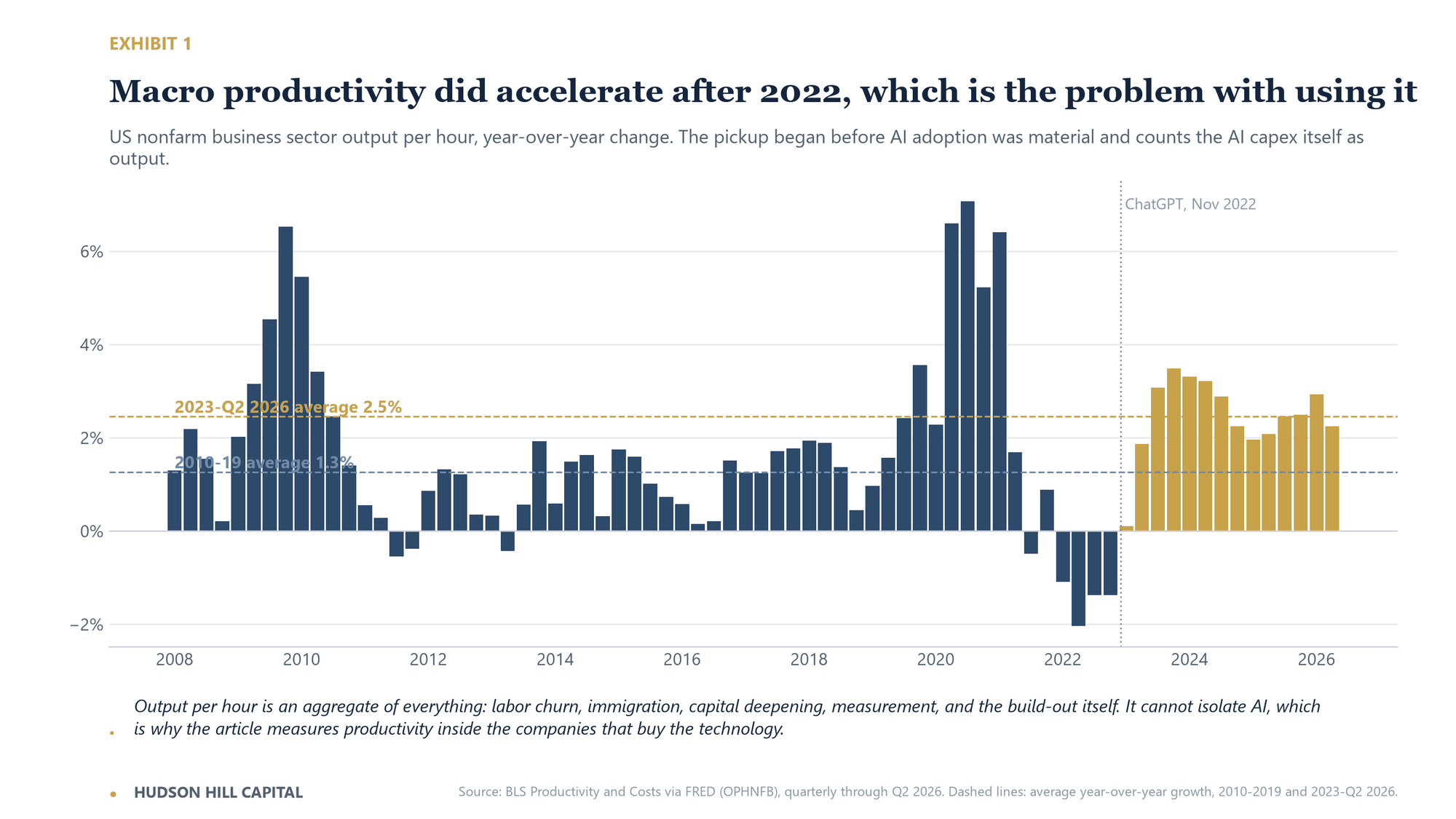
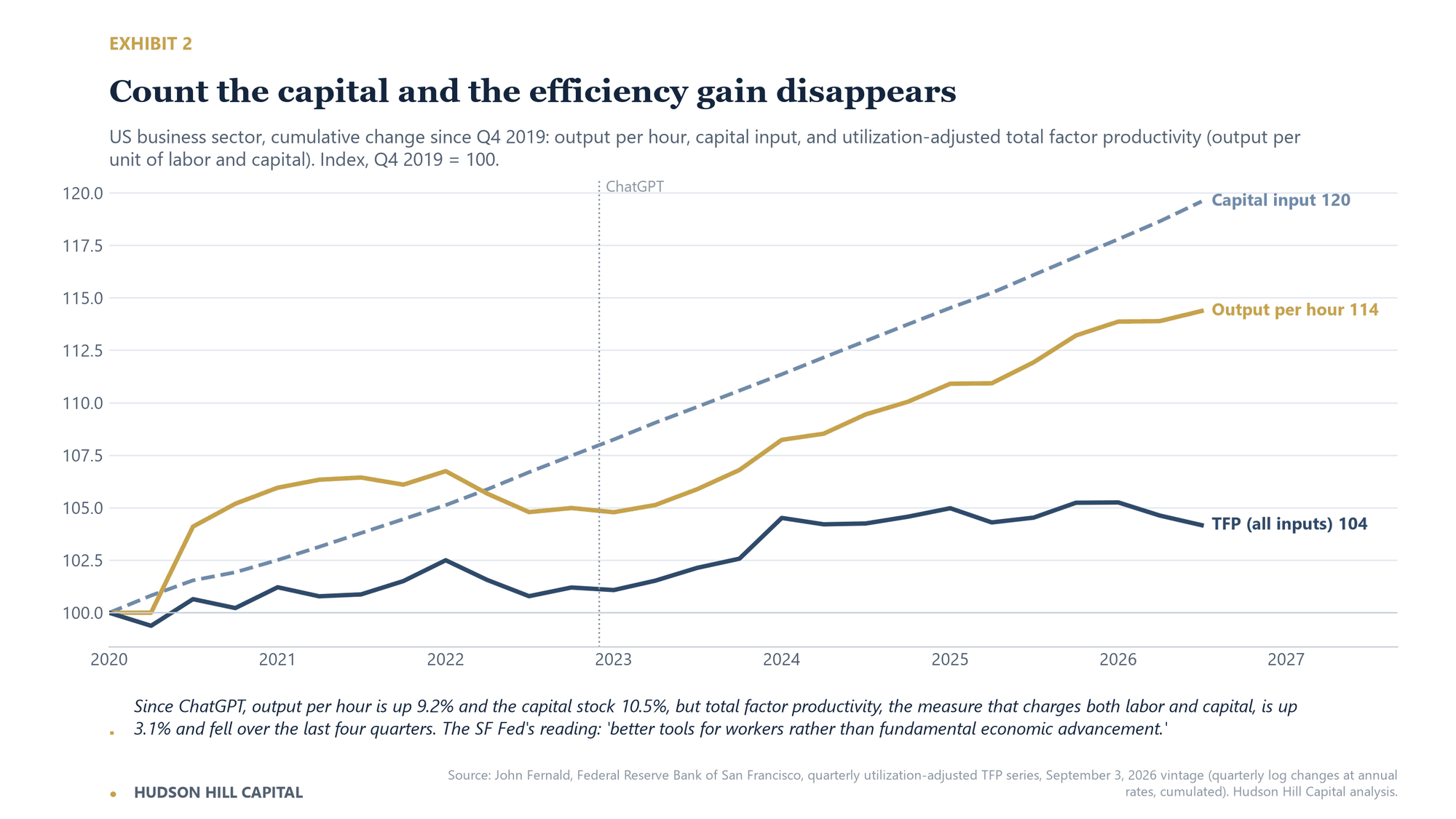
Productivity accelerates immediately following the introduction of ChatGPT, and it is, of course, tempting to credit this to the advent of AI. In 2023, when macro productivity began to accelerate, fewer than 4% of firms used AI (3.7% in the Census Bureau’s September 2023 survey), which suggests that AI software productivity gains played only a small role in this acceleration. But if you look at the San Francisco Fed’s utilization-adjusted statistics, total factor productivity rose just 0.3% in 2025 and fell 0.3% over the four quarters to Q2 2026, while capital input grew 2.8% a year. In other words, once capital is charged as an input, the productivity gain largely disappears.
Despite limited macro support for the impact of AI on productivity, large public companies continue to spend lavishly to build out the data centers required for its delivery to enterprises and consumers. To support their near-term capital expenditures, AI hardware and software builders must assume significant future increases in revenue and operating profit. That revenue can come from only two places: customers who become more productive and pay for AI, or customers who pay more for the builders’ existing products.
Following The Money
Microsoft, Alphabet, Amazon, Meta, and Oracle have guided to $810-840 billion of capital expenditures in 2026, up from $408 billion in 2025 and $87 billion in 2019 – with most of these investments directed towards AI. Consensus puts the total at about $1.1 trillion in 2027 and $1.3 trillion in 2028.
The buildout started with monopolistic technology companies utilizing retained earnings to finance investments in new technology. As the buildout accelerated, the companies participating continued to increase investments. In 2026, they hit the ceiling of what operating cash flow can fund: capex consumed 36% of the five companies’ operating cash flow in 2019, 66% in 2025, and 97% in Q2 2026, leaving $4.8 billion against roughly $81 billion a year of buybacks and dividends.
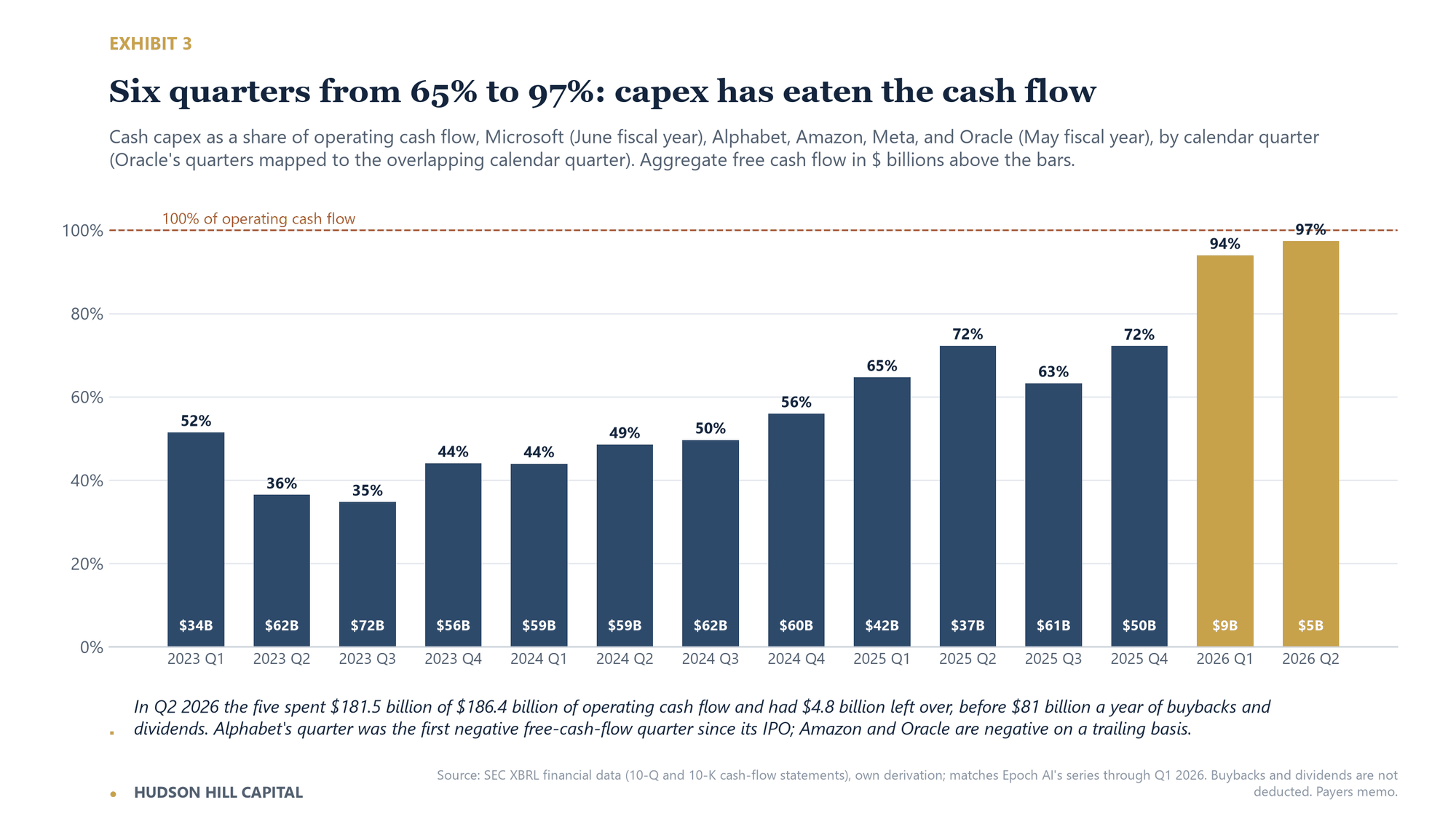
As a result, these companies are entering the debt and equity markets to raise capital to support the continued growth in their investments. Through early October 2026, they raised roughly $290 billion, about $221 billion of bonds and $70 billion of equity, led by Alphabet’s $49.6 billion and Oracle’s $19.9 billion. These numbers do not incorporate the private and public financing of Anthropic, OpenAI, or SpaceX, which exceeds $300 billion YTD and could increase by another $130 billion by the end of 2026.
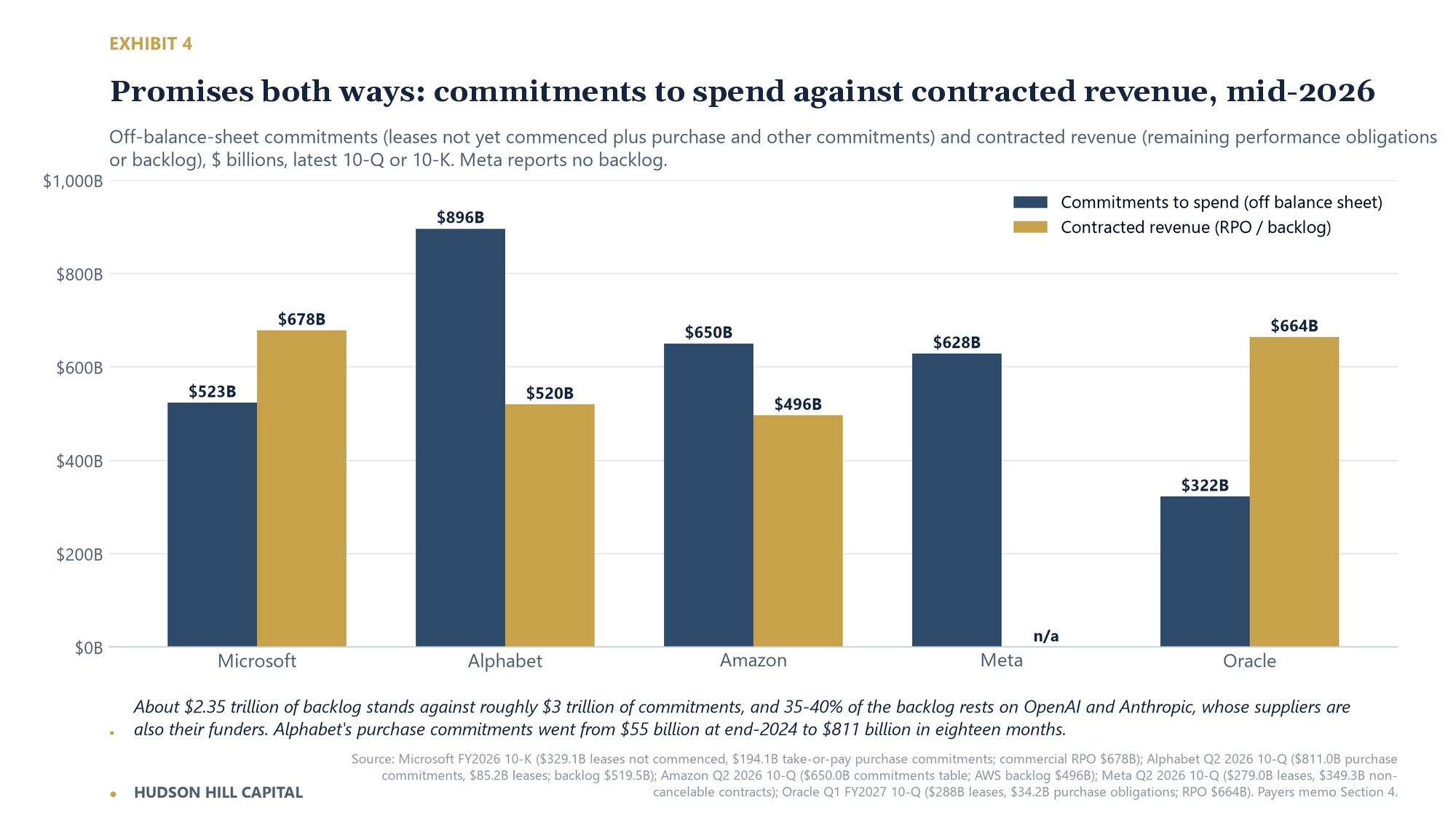
As of October 2026, five large technology companies have made $3 trillion of spending commitments against $2.35 trillion of revenue backlog – of which 35-40% rests with OpenAI and Anthropic. OpenAI alone accounts for about 45% of Microsoft’s commercial backlog and about 50% of Oracle’s.
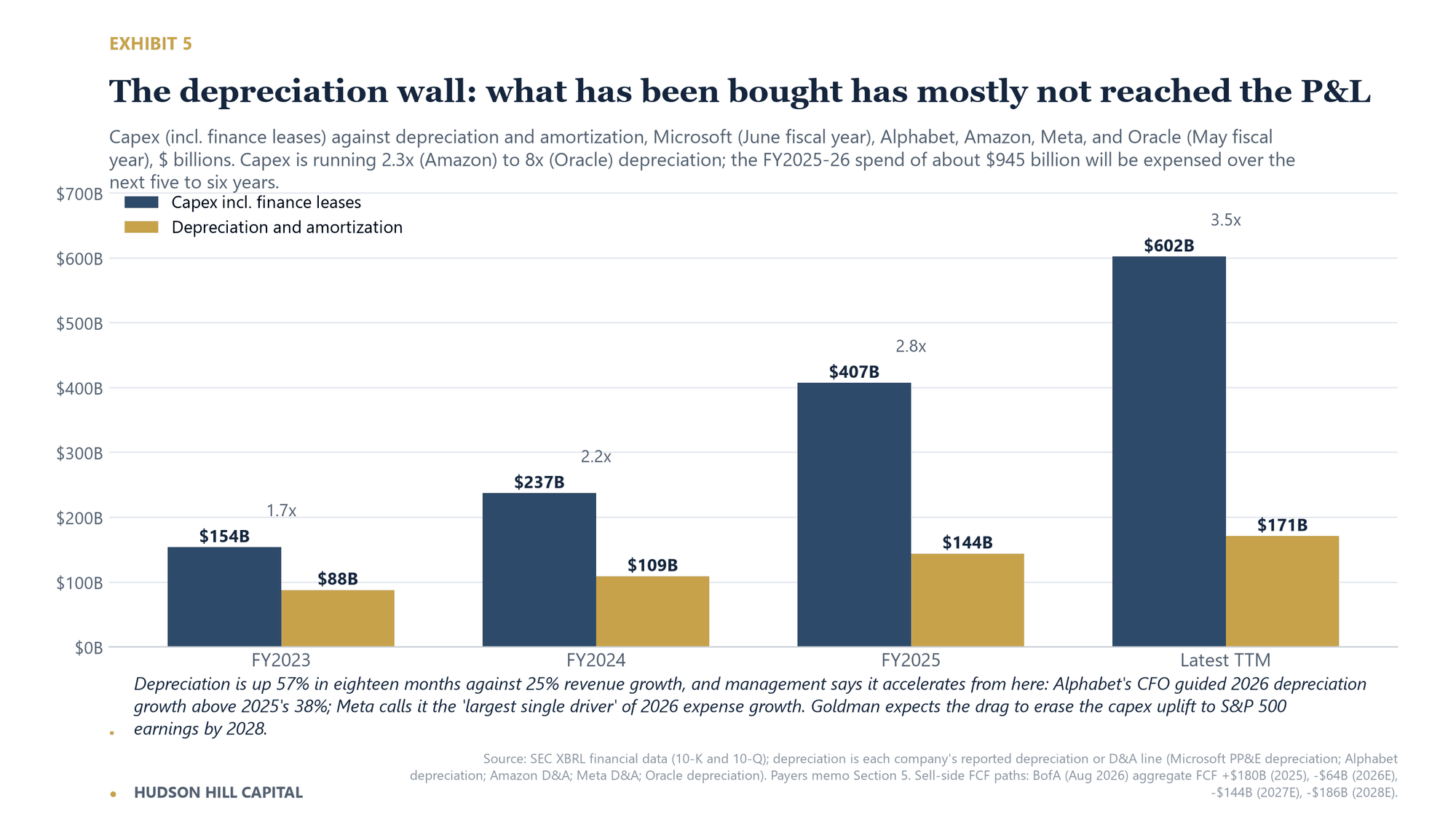
As a result of these capital expenditures, large technology companies will see a significant increase in depreciation and amortization relative to what is currently expensed on their income statements. These recent investments have been recognized in the financial statements on the balance sheet and cash flow statement, largely bypassing the income statement, which is the primary focus of public equity investors. That is changing. Capex now runs 2.3x (Amazon) to 8x (Oracle) depreciation, and five-company depreciation has already risen from $88 billion in 2023 to $171 billion over the latest twelve months, up 57% against 25% revenue growth. Goldman estimates depreciation will cut 5% from 2027 S&P 500 earnings growth.
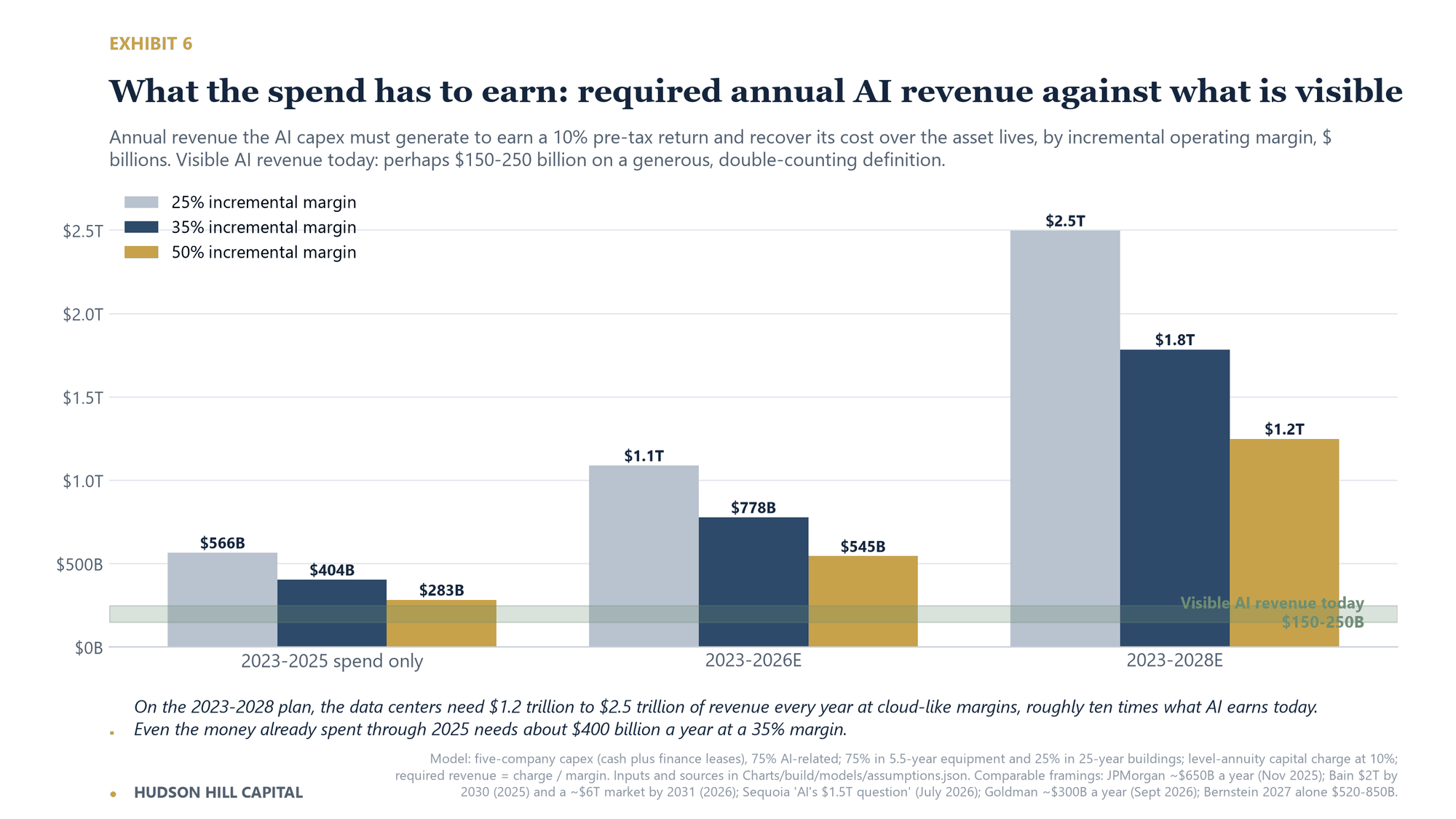
The AI-driven capital investments made by five technology companies require a return to justify the outlays. At varying levels of margin on AI revenue, these historical investments require material revenue increases. On our base case (2023-2028E capex of about $3.9 trillion, 75% AI-related, 5.5-year equipment and 25-year building lives, a 10% pre-tax return), the five need about $625 billion a year of operating profit: $1.8 trillion of AI revenue at a 35% margin, against perhaps $150-250 billion visible today. The investments planned for 2027 and 2028 also significantly increase the AI revenue and operating margin requirement. Each additional year of buildout increases the amount of AI revenue required to justify the investment. Currently observed ROIs for AI investments likely overestimate the ultimate returns once the ballast of this capital investment becomes operational. To quote Chancellor’s capital cycle, “High profitability loosens capital discipline in an industry. When returns are high, companies are inclined to boost capital spending. Competitors are likely to follow.” From railways and real estate to telecommunications and solar power, history is riddled with examples of overinvestment due to early returns to capital. In telecommunications, more than $500 billion was invested between 1996 and 2002; bondholders recovered about 20 cents on the dollar, and as little as 2.6% of the fiber was lit.
Supplier Nirvana
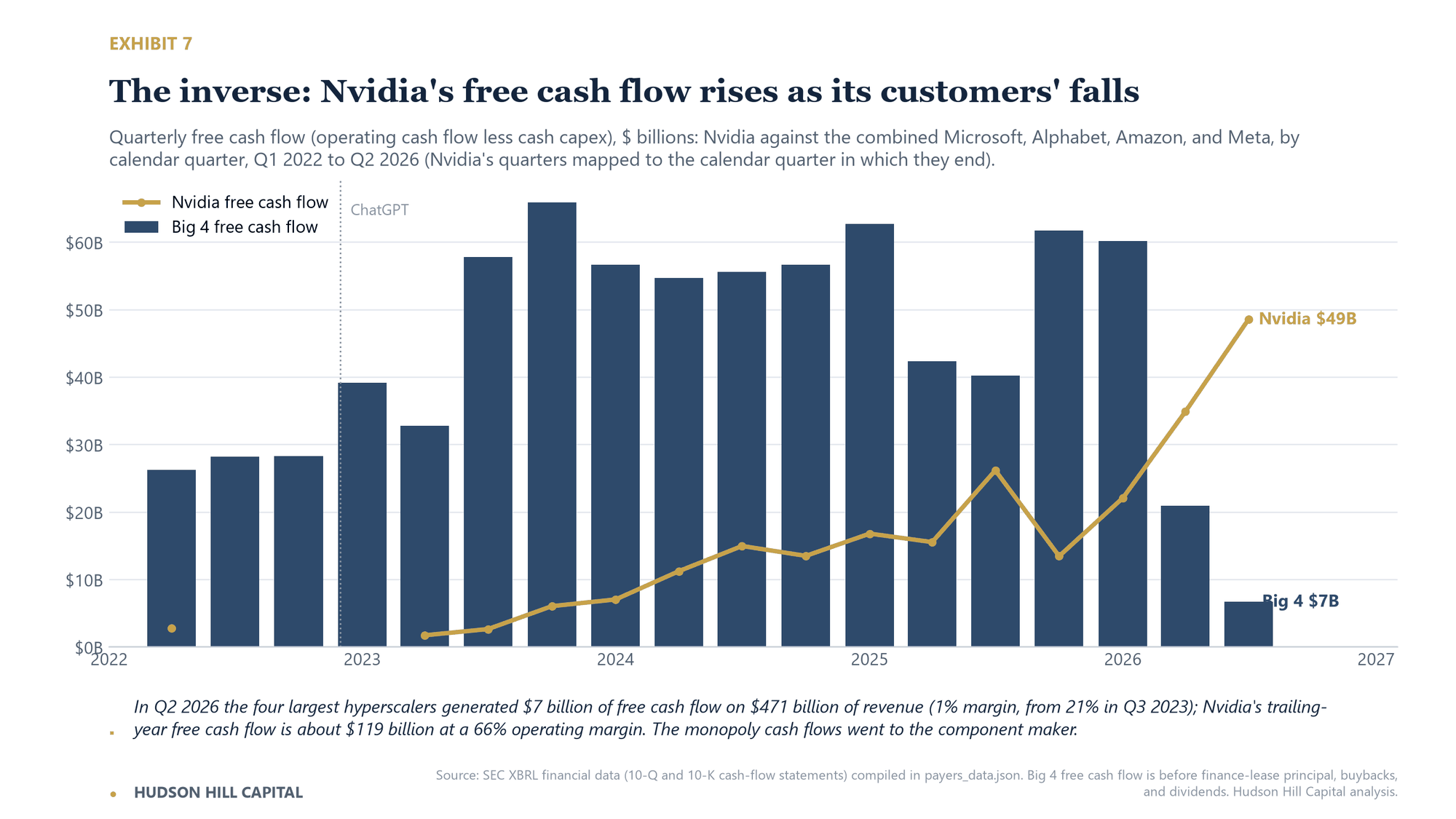
The current state of the AI buildout looks like nirvana for suppliers, as AI builders (Oracle, Google, Amazon, Meta, Microsoft) use capital expenditures that don't yet hit the income statement to support the statements of AI suppliers (Nvidia, Dell, AMD, TSMC). Free cash flow has moved rapidly from asset-light digital monopolies into the AI supply chain: in Q2 2026, the four largest hyperscalers generated $6.7 billion of free cash flow on $471 billion of revenue (a 1.4% margin, down from 16% in Q3 2024), while Nvidia alone generated $49 billion.
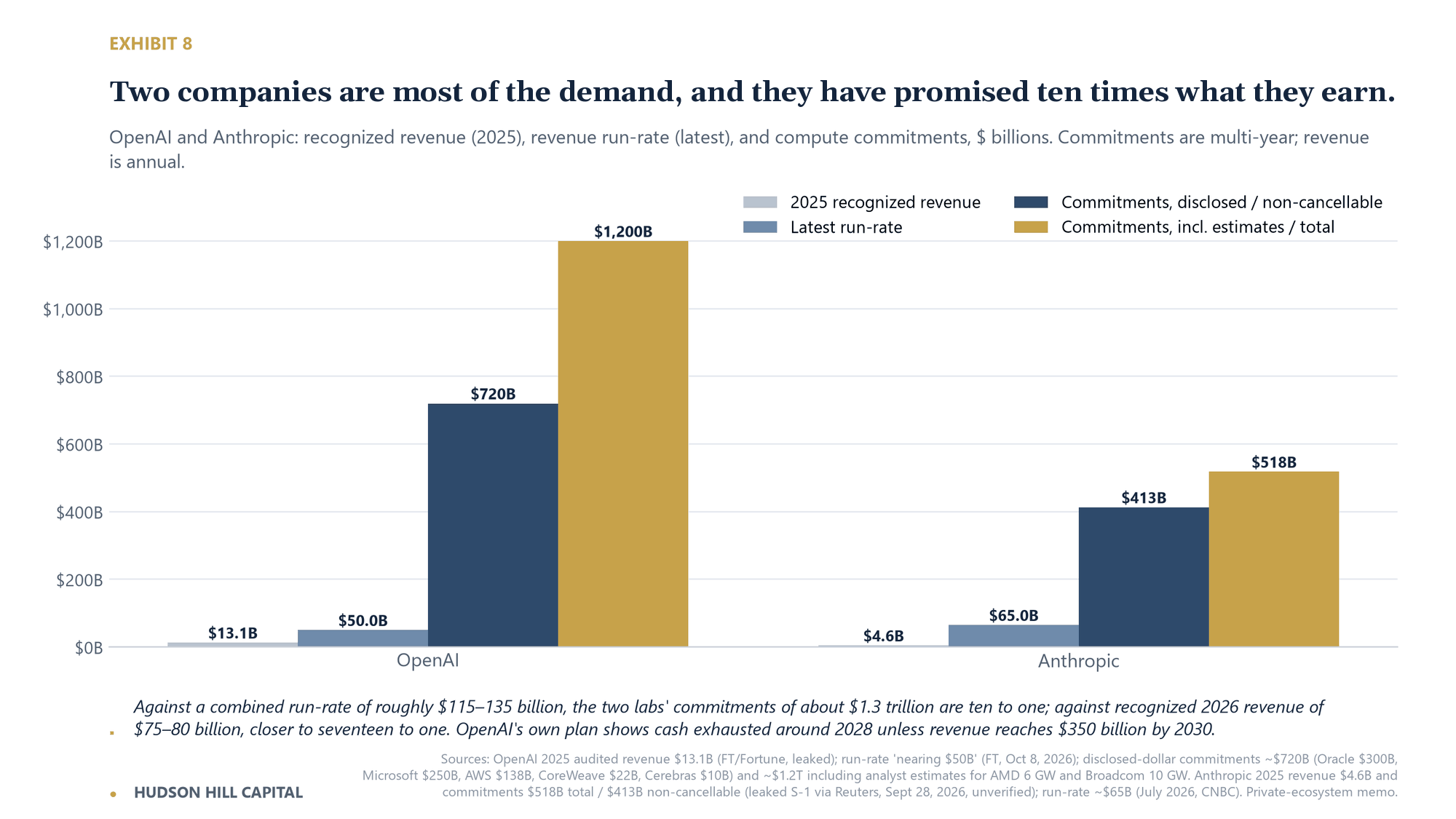
The profit signal supporting the AI buildout originates in the growth and virality of two companies – OpenAI and Anthropic. Both ChatGPT and Claude Code represent meaningful steps forward in consumer and enterprise technology, quickly achieving product-market fit with millions of customers. To support product growth, both companies contracted significant forward compute capacity for training and inference. Their combined compute commitments of roughly $1.3 trillion are about 10x their combined revenue run-rate of $115-135 billion, and about 17x their 2026 recognized revenue.
Passing Through the Costs
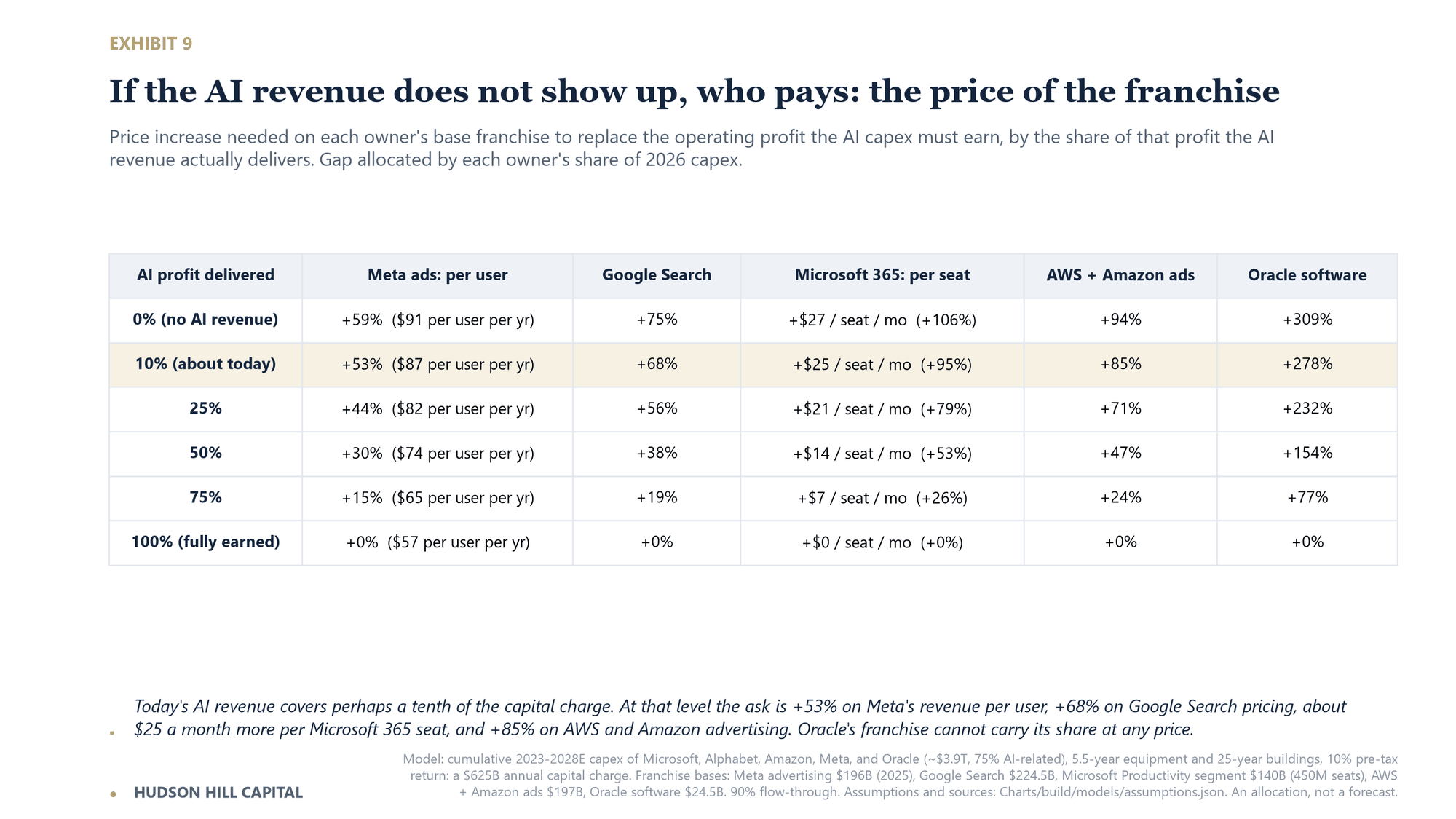
Most AI commentary stops here. OpenAI and Anthropic may struggle to grow their revenue to support these spending commitments. Certain commentators then conclude that the ecosystem will implode, with cascading bankruptcies and financial distress. This conclusion ignores the context that drove the industry to this point: monopoly asset-light digital businesses provided the free cash flow to finance the early stages of the technology’s development and capital buildout. As a result, the large monopolists funding the AI buildout will likely shift focus back to their core businesses to seek return for these capital outlays. As the table below lays out, AI profit disappointment likely leads to higher prices for the core products of Meta, Google, Microsoft, and AWS to offset meaningful AI investments.
In our base case, if AI revenue earned none of the required return, filling the gap from the core franchises would require Meta to increase revenue per user by 59%, Google Search to raise pricing by 75%, and Microsoft to receive roughly $27 more per month per Microsoft 365 commercial seat. As a result, consumers and businesses should expect to pay for AI, whether it drives productivity or not.
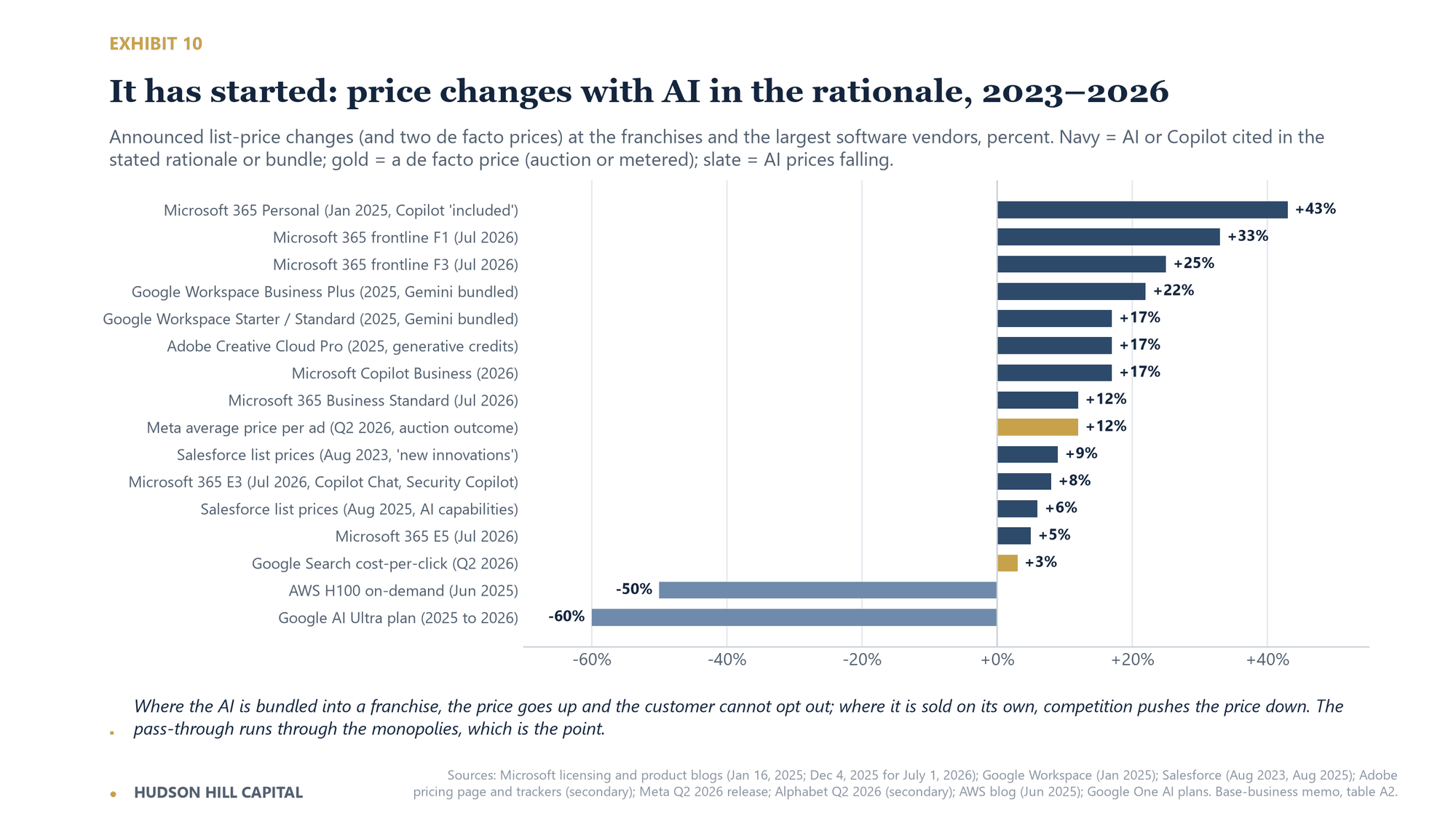
We are already observing this phenomenon in recent pricing announcements by the large technology companies. Prices for software and services at Microsoft, Google, Adobe, Salesforce, and AWS have all increased meaningfully when bundled with AI features (Microsoft 365 E3 rose from $36 to $39 per seat in July 2026 with Copilot Chat included; Google Workspace rose 17-22% with Gemini bundled), while AI sold on its own has fallen in price (Google cut its AI Ultra plan from $249.99 to $99.99). The pass-through has begun, though it is still small against the gap: $ 1-3 per seat on 450 million Microsoft seats is about $16 billion a year, against $116 billion of Microsoft capex.
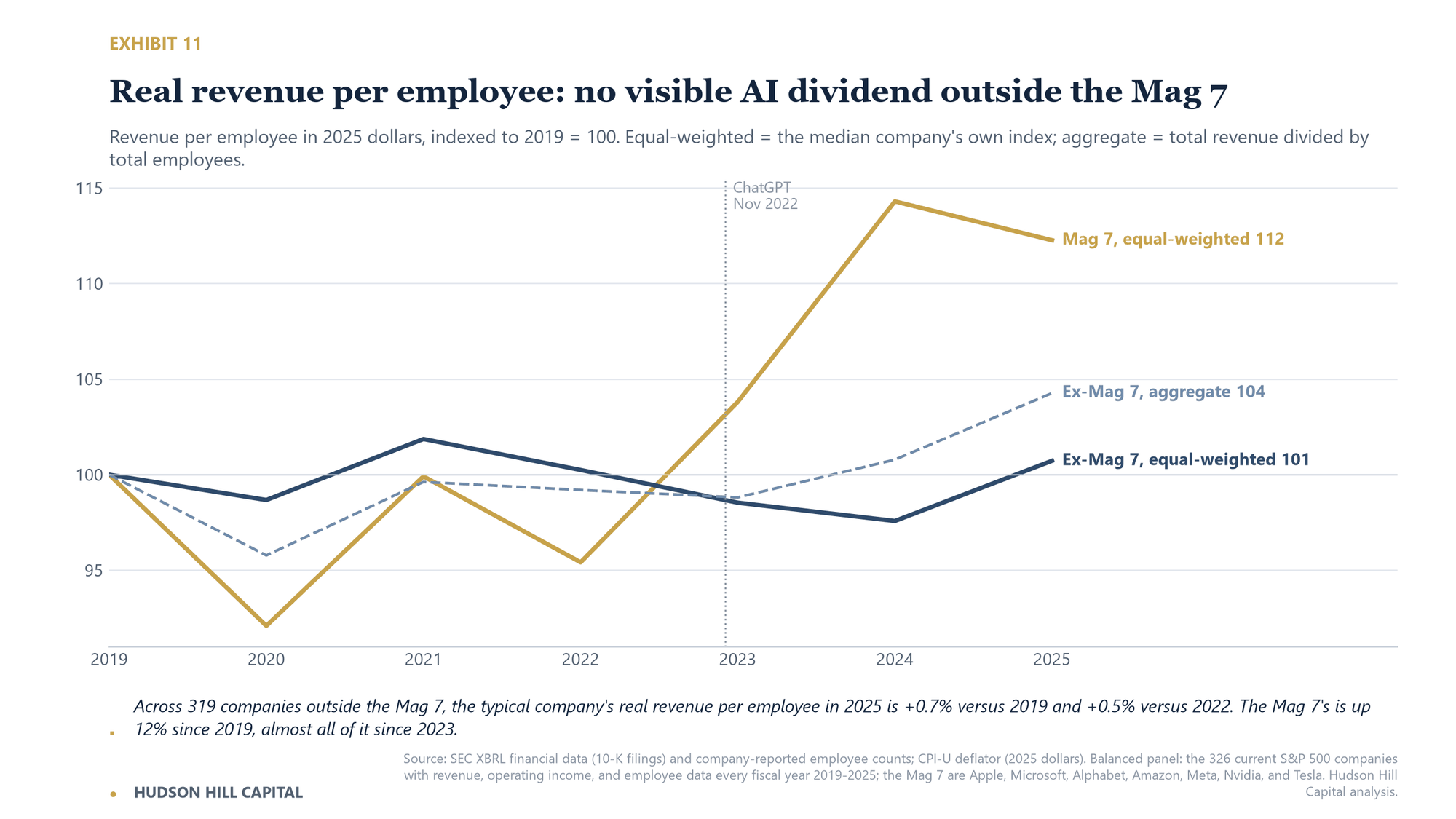
AI will either produce meaningful increases in productivity when accounting for the increase in capital outlays, or it will destroy productivity by increasing the capital intensity for similar levels of output. HHC tracks two KPIs to measure the outcome of AI’s buildout: revenue and operating profit per employee for public companies. Excluding the Mag 7, whose results are distorted by their role in the buildout, the typical company in our S&P 500 panel produced the same real revenue per employee in 2025 as in 2019 and 2022 (an index of 100.7 versus 100.0 and 100.3).
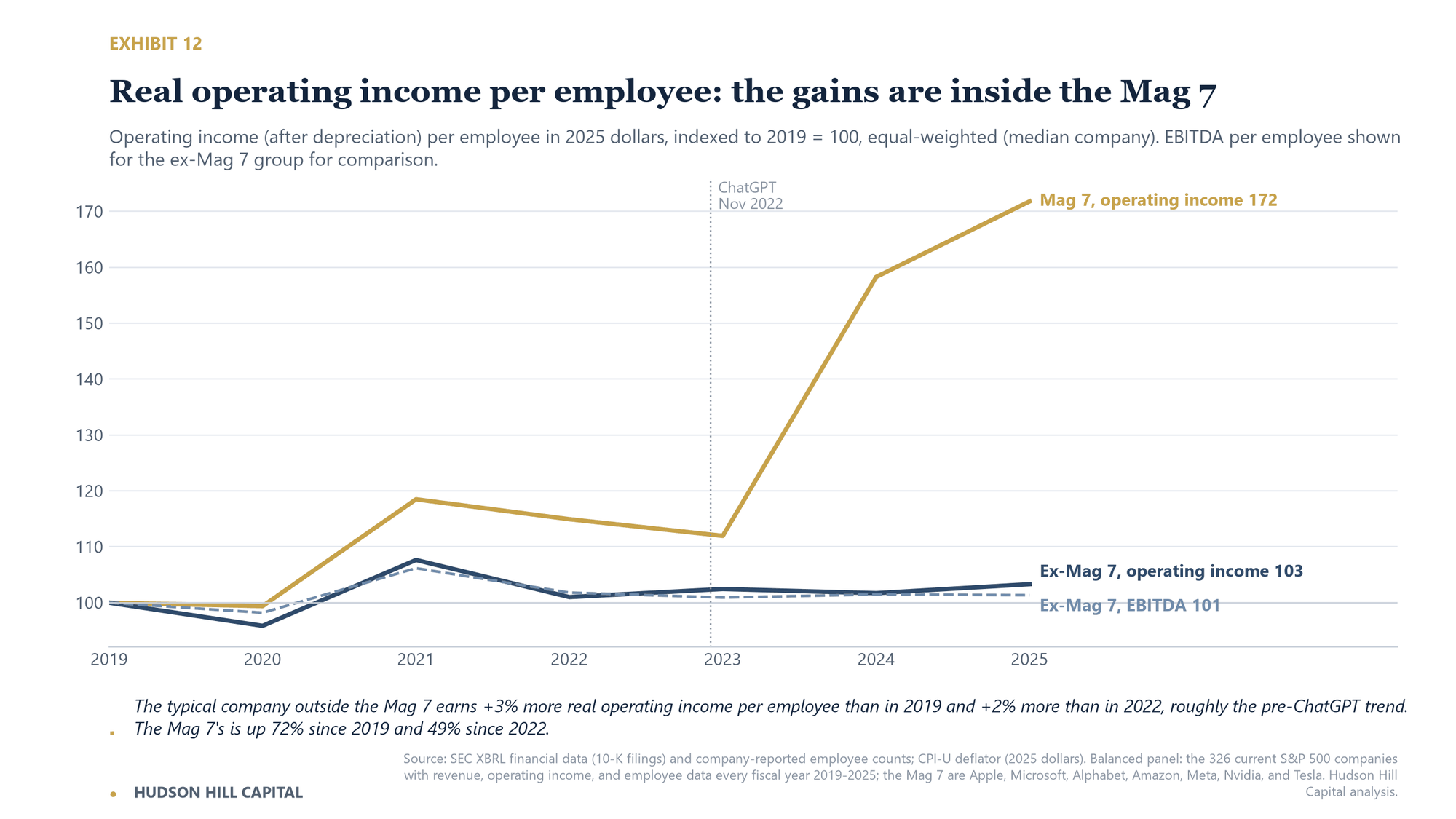
At the same time, real operating income per employee for S&P 493 has barely moved: up 3.3% over six years, the same pace as before ChatGPT. Roughly half of companies improved both before and after ChatGPT – a coin flip. If AI delivers radical productivity gains for businesses, these metrics will shift, but so far, we’ve yet to see it.
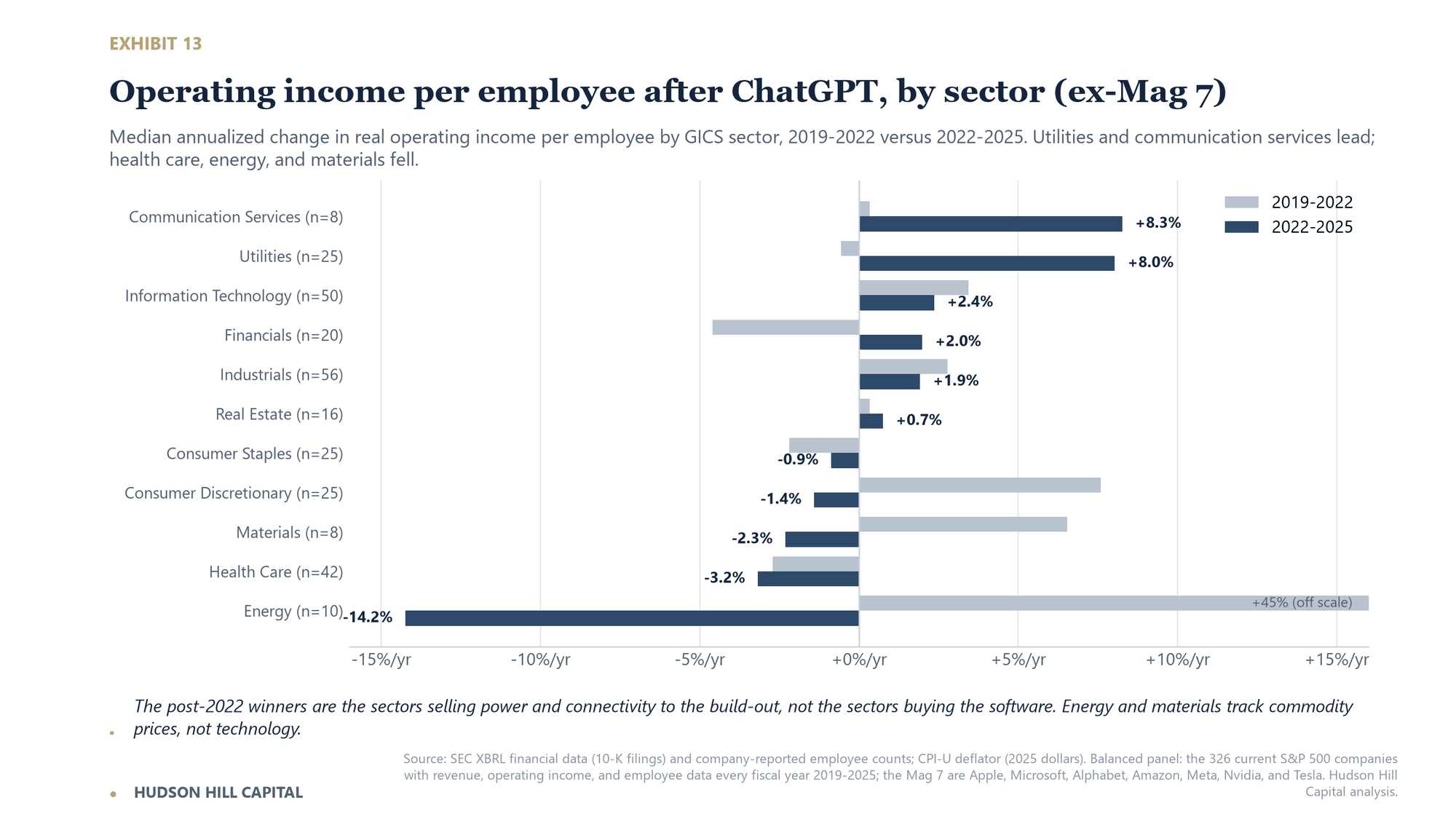
Across the S&P 500, the largest post-2022 gains in operating income per employee came in sectors that sell to the buildout: Communication Services (+8.3% a year) and Utilities (+8.0%), while Health Care (-3.2%) and Materials (-2.3%) declined. The AI buildout’s speed and various bottlenecks led to price increases that flatter these figures and create the perception of productivity increases. Until all companies that purchase and use AI in their businesses observe inflections in revenue and operating profit per employee, it is hard to argue that AI is impacting the economy favorably.
Job losses remain the greatest fear the AI complex has instilled in the average American since ChatGPT launched. Despite exhaustive media coverage in search of confirmatory findings, headcount within the S&P 500 (19.8 million in 2022, 19.7 million in 2025 for our ex-Mag 7 panel) – even the Mag7 – is flat. Announced AI-attributed job cuts (120,136 through September 2026, per Challenger) have not yet shown up in the headcount of the largest companies. AI dividend delayed, perhaps.
The consensus, held by almost everyone, is that AI is a productivity tool whose returns are only a matter of time. The data so far says that AI buyers are producing no more per worker than before. When factoring in all the inputs (labor, capital, and the energy to run it), flat operating income per worker implies a decline in productivity because of AI. The mechanism is plausible: in a 2025 METR randomized trial, experienced developers working in their own codebases took 19% longer with AI tools while believing they were 20% faster. (METR’s 2026 follow-up points to speedups it says it can no longer measure reliably.)
With so much consensus lined up in favor of AI’s productivity dividend, analytical support for the technology’s impact feels like a basic requirement. At least today, that analytical support is lacking.