
Private Credit Is the New Banking System

Key Takeaways
Private credit is a regulatory consequence, not a mania. Dodd-Frank's capital charges, via Basel III and the Volcker Rule, made leveraged corporate lending unprofitable for banks. Borrower demand didn't disappear; it changed address.
Leverage itself is not the villain. Fractional-reserve banking channels idle savings into productive loans. Within optimal parameters, leverage is a pro-growth feature of the modern financial system.
The deposit base moved too, not just the loan book. After the Fed began hiking in 2022, roughly $874B left bank deposits and money-market funds grew nearly $3T to $7.75T. Annuity sales hit a record $434B in 2024.
Maturity mismatch is the actual source of banking crises. Banks fund 5–7-year loans with money that can leave in a day; Silicon Valley Bank lost roughly a quarter of its deposits in a single day. Private credit funds 5–7-year loans with 5–20-year liabilities.
Losses are boxed, not transmitted. Each fund carries its own equity cushion, spread across many investors. Realized losses in direct lending have averaged about 1% a year, below comparable high-yield bonds. Redemption gates are the system working as designed.
Why “debt is dangerous” is the wrong framing
One narrative has bothered me as a consumer of financial media over the past year: that “private credit is blowing up.” Private credit emerged to meet significant market demand after the Dodd-Frank regulations made lending uneconomical for traditional banks. Funds stepped in first, and integrated insurance platforms followed, supplying loan capital to the consumers and businesses whose financing needs persist regardless of the regulatory environment.
A popular misconception that traces through all commentary on the topic of private credit is that debt is inherently dangerous. In fact, leverage, within optimal parameters, is a pro-growth, essential feature of the modern global financial system. Fractional-reserve banking is one of civilization’s great inventions precisely because it channels idle savings into productive assets – loans to businesses and consumers. Demand for business loans is an essential feature of a growing economy, and in moderation it compounds into real gains for institutional investors.
The media’s discussion of private credit often overlooks these benefits. The real story is simpler: it's about who holds the ultimate risk of credit failure, and how that risk gets funded.
Regulatory changes over the past 27 years created the conditions for private credit to grow. In 1999, the Gramm-Leach-Bliley Act repealed Glass-Steagall, which had separated commercial and investment banking since the Great Depression. That repeal enabled a consolidation of risk assets inside a handful of large institutions – funded with on-demand consumer and business deposits – that helped set the stage for the Global Financial Crisis. To address that concentration, Congress passed the Dodd-Frank Act. Its higher capital charges against certain risk assets, chiefly through Basel III and the Volcker Rule, made traditional leveraged lending to businesses less profitable for banks. Banks could still make loans, but regulation constrained their ability to scale this activity while the market’s demand for business credit kept growing with GDP. So, borrowers turned to the lenders who would still underwrite that risk: private credit.The numbers are :
The numbers are stark:
Private credit AUM is on track for a ~10x increase, rising from roughly $300 billion in 2010, when Dodd-Frank passed, to nearly $2 trillion today and an expected nearly $3 trillion in 2028
Banks’ share of the leveraged-loan market collapsed from about 70% in the mid-1990s to under 10% by 2018
Banks' share of all corporate lending fell from 48% in 2015 to 29% by 2025
Bank lending has shrunk relative to the economy as well, from about 10% of GDP before the Global Financial Crisis to 8.7% in 2025, far slower than the economy and the private credit market around it
Dodd-Frank did exactly what its capital rules incentivized: it pushed higher-risk lending out of the banking system and into a private credit ecosystem that grew to serve the demand. Private credit now rivals the entire syndicated leveraged-loan market in size, financing roughly 90% of tracked buyout loans in the first half of 2023.
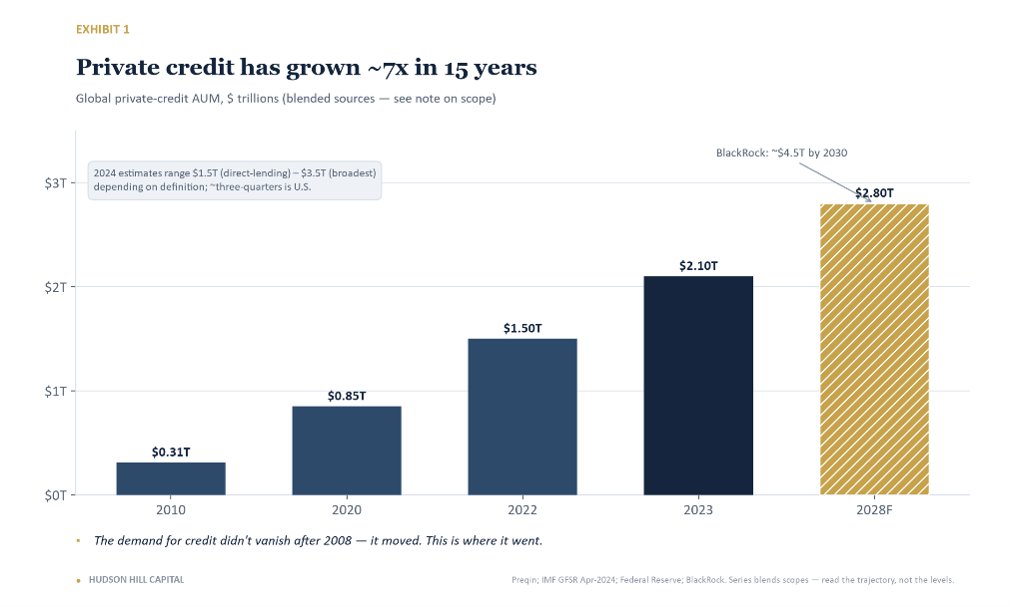
Exhibit 1 — Private credit has grown ~7x in 15 years. Global private-credit AUM, $ trillions (blended sources). 2024 estimates range from $1.5T (direct-lending only) to $3.5T (broadest definition); roughly three-quarters is U.S. The demand for credit didn't vanish after 2008 — it moved. This is where it went.
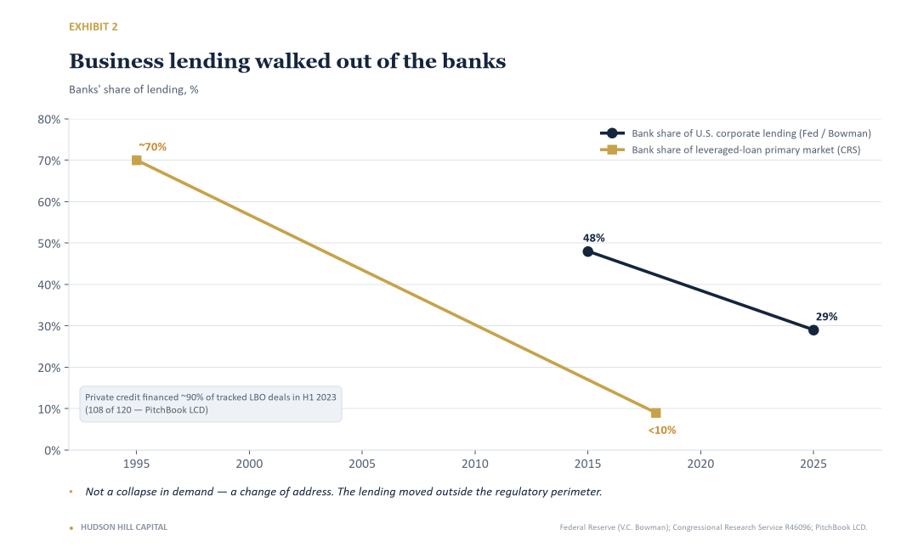
Exhibit 2 — Business lending walked out of the banks. Banks' share of lending, %. Private credit financed ~90% of tracked LBO deals in H1 2023 (108 of 120). Not a collapse in demand — a change of address. The lending moved outside the regulatory perimeter.
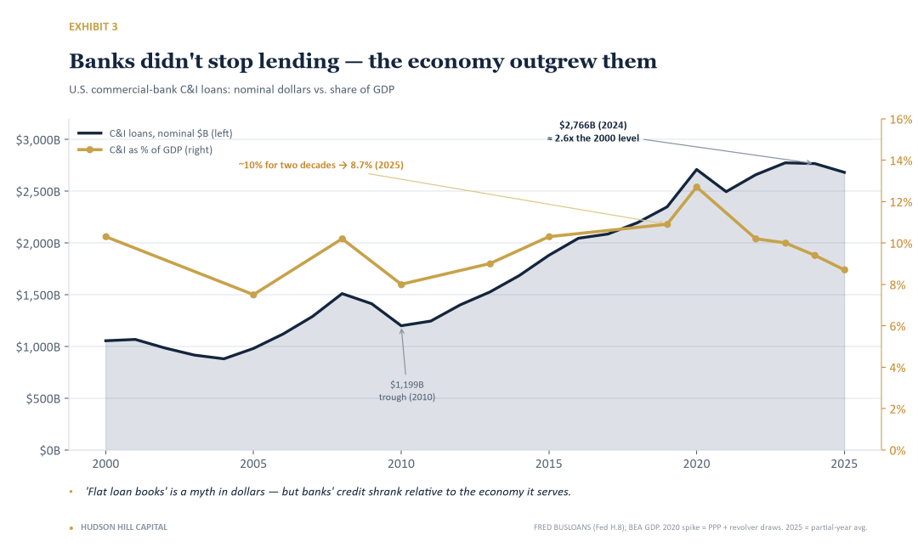
Exhibit 3 — Banks didn't stop lending; the economy outgrew them. U.S. commercial-bank C&I loans: nominal dollars vs. share of GDP. “Flat loan books” is a myth in dollars — but banks' credit shrank relative to the economy it serves.
The second-order effect: deposits followed the loans
This shift had a downstream effect: banks’ return on assets fell relative to other lenders. Banks have traditionally used the return on their assets, loans, to pay yield to their depositors as checking- and savings-account interest. Under the Zero Interest Rate Policy (ZIRP), banks paid almost nothing on savings. Banks faced no pressure from depositors because money market funds, fixed-income mutual funds, certificates of deposit, and annuities all yielded almost nothing. Banks earned less on their assets, but their cost of funding was effectively zero, so the erosion didn’t existentially threaten the banking business model.
That changed in 2022 when the Federal Reserve began raising rates and depositors went looking for yield. The result was a migration out of the banking deposit base and into higher-yielding alternatives:
Money-market fund assets swelled by nearly $3 trillion to $7.75 trillion, and banks shed roughly $874 billion of deposits in the year to mid-2023, their first annual decline since 1995.
Annuities captured much of the flow, with sales hitting a record $434 billion in 2024.
A bank savings account paid well under 1% while a fixed annuity paid around 5%.
Crucially, this money is stickier than a demand deposit, and it increasingly funds private credit through integrated platforms like Apollo/Athene, KKR/Global Atlantic, and Brookfield/AEL.
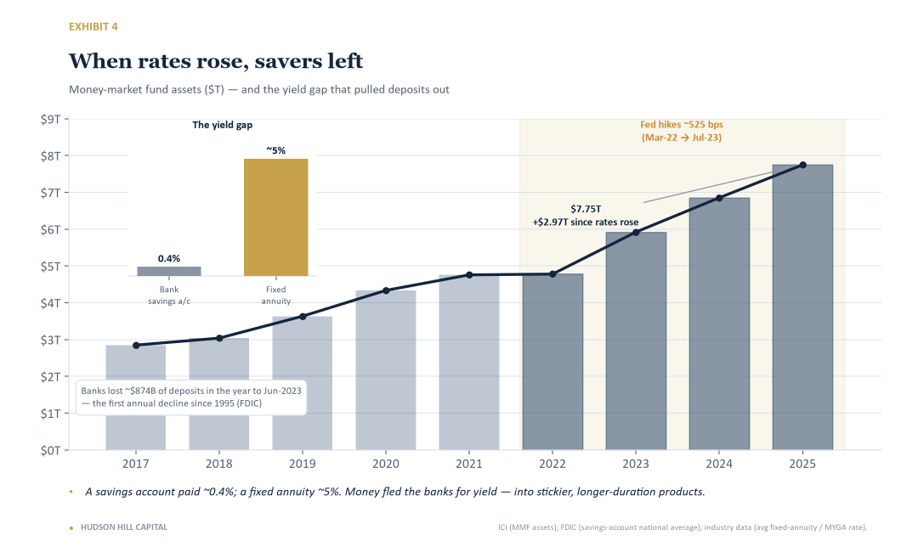
Exhibit 4 — When rates rose, savers left. Money-market fund assets ($T) and the yield gap that pulled deposits out. Banks lost ~$874B of deposits in the year to Jun-2023, the first annual decline since 1995 (FDIC). A savings account paid ~0.4%; a fixed annuity ~5%. Money fled the banks for yield — into stickier, longer-duration products.
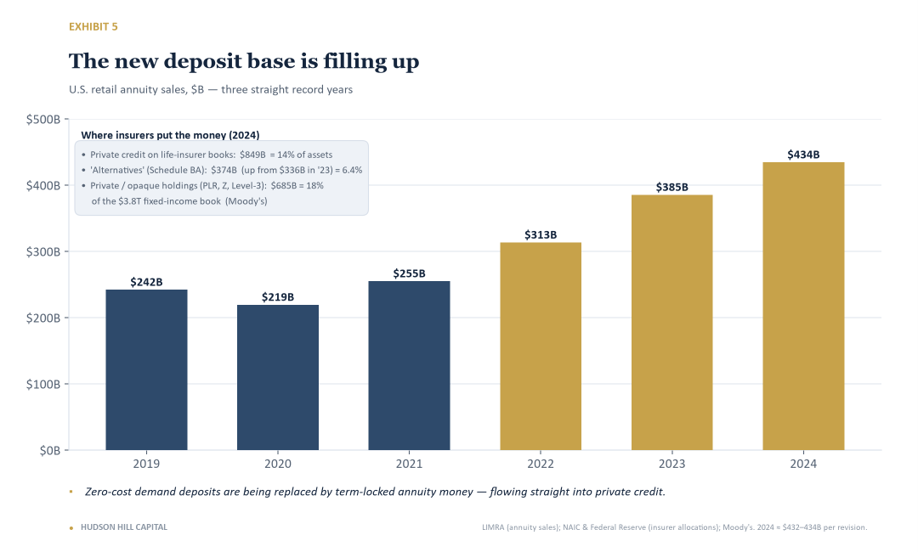
Exhibit 5 — The new deposit base is filling up. U.S. retail annuity sales, $B — three straight record years. Zero-cost demand deposits are being replaced by term-locked annuity money, flowing straight into private credit.
Why vertical integration beats traditional banking
Vertically integrated, this deposit-and-lending structure is a far better model than traditional banking. A bank funds long-duration assets with on-demand deposits, and that maturity mismatch has driven every banking crisis in history. Regardless of asset quality, a run on deposits forces insolvency. Silicon Valley Bank lost roughly a quarter of its deposits in a single day. That mismatch is the very risk Dodd-Frank set out to contain. Instead, it pushed both deposits and lending out of the banking system.
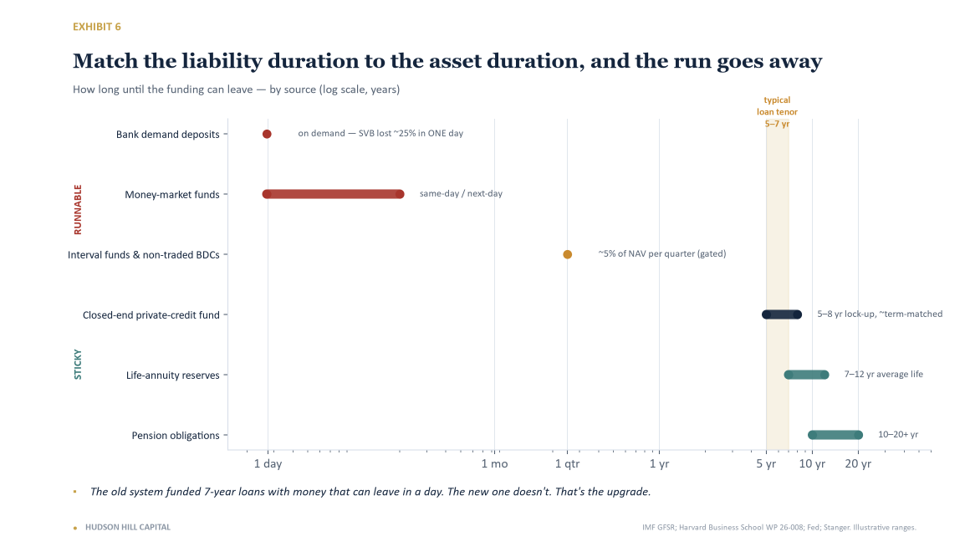
Exhibit 6 — Match the liability duration to the asset duration, and the run goes away. How long until the funding can leave, by source (log scale, years). The old system funded 7-year loans with money that can leave in a day. The new one doesn't. That's the upgrade.
Private credit is a feature, not a bug
Private credit is a feature of this new system, not a bug. It is financed primarily with equity capital and long-duration liabilities, and its loan books sit inside funds that each carry their own equity cushion.
Losses are boxed. When credit problems surface in a single fund, the losses are contained within that fund’s equity rather than transmitted across the system.
Funding is sticky. The liabilities funding these vehicles are sticky, with redemptions restricted relative to demand deposits at banks; even broad deterioration in credit quality is far less likely to trigger the cascading runs that define traditional banking crises.
Risk is dispersed. Instead of exposing a single or several banks, risk is spread widely and therefore mitigated across the funds’ more numerous investors.
Realized losses have stayed contained. Direct lending has averaged about 1% a year, below comparable high-yield bonds.
Gates are the mechanism, not the malfunction. High redemption requests and subsequent gates limiting withdrawals within large, publicly traded private credit funds indicate the new banking system is working, not dysfunctional.
Savers once took responsibility for the financial contract they engaged in with their banking counterparty assuring them yields on savings and this new system requires the same level of depositor responsibility.
What the next downturn will look like
These changes arguably represent a meaningful improvement in the systemic risk structure of our banking system, and the growth of private credit should be celebrated, not condemned. A contraction will come, as it does in every leverage cycle, and poor lending decisions will become apparent. That said, the next credit cycle downturn will feature real circuit breakers through boxed losses inside of funds and sticky funding through long-term savings products, which should keep a credit cycle downturn from creating deleterious effects on the Main Street economy.